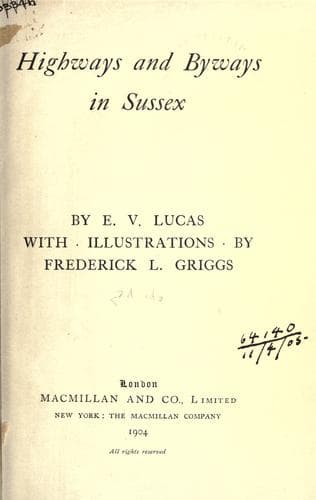
Highways and Byways in SussexLucas, E. V. (Edward Verrall)
History
Highways and Byways in Sussex
Lucas, E. V. (Edward Verrall)
Sussex (England) -- Description and travel
Although less than half an hour from Brighton by train, and an hour by
road, Lewes is yet a full quarter of a century behind it. She would do
well jealously to maintain this interval. Lewes was old and grey before
Brighton was thought of (indeed, it was, as we have seen, a Lewes man
that discovered Brighton--Dr. Russell, who lies in his grave in South
Malling church); let her cling to her seniority. As a town "in the
movement," as a contemporary of the "Queen of Watering Places," she
would cut a poor figure. But it is amusing to think of the old address
of a visitor to Brighton, "at Brighthelmstone, near Lewes," and to read
the county paper, _The Sussex Weekly Advertiser; or, Lewes Journal_, of
a century ago, with its columns of Lewes news and paragraphs of Brighton
correspondence. Lewes will cease to have charm the moment she
modernises. In the words of the author of _Idlehurst_, as he looked down
on the huddling little settlement from the Cliffe Hill: "Let us keep a
country town or two as preserves for clean atmospheres of body and soul,
for the almost lost secret of sitting still.... I find myself tangled
in half-dreams of a devolution by which, when national amity shall have
become mentionable besides personal pence, London shall attract to
herself all the small vice, as she does already most of the great, from
the country, all the thrusters after gain, the vulgar, heavy-fingered
intellects, the Progressive spouters, the Bileses, the speculating
brigandage, and shall give us back from the foggy world of clubs and
cab-ranks and geniuses, the poets and painters, all the nice and witty
and pretty people, to make towns such as this, conserved and purified,
into country-side Athenses; to form distinct schools of letters and art,
individual growths, not that universal Cockney mind, smoke-ingrained,
stage-ridden, convention-throttled, which now masquerades under the
forms of every clime and dialect within reach of a tourist ticket."
The customs of Lewes at the end of the Saxon rule and the beginning of
the Norman, as recorded in the pages of the Domesday Book, show that
residence in the town in those days was not unmixed delight, except,
perhaps, for murderers, for whom much seems to have been done. Thus: "If
the king wished to send an armament to guard the seas, without his
personal attendance, twenty shillings were collected from all the
inhabitants, without exception or respect to particular tenure, and
these were paid to the men-at-arms in the ships.
"The seller of a horse, within the borough, pays one penny to the mayor
(sheriff?) and the purchaser another; of an ox, a half-penny; of a man,
fourpence, in whatsoever place he may be brought within the rape.
"A murderer forfeits seven shillings and fourpence; a ravisher forfeits
eight shillings and fourpence; an adulterer eight shillings and
fourpence; an adultress the same. The king has the adulterer, the bishop
the adulteress."
[Sidenote: THE PROVIDENT DE WARENNES]
Public-domain text, read in full here on John Shaqi.
Reviews
Reviews
No reviews yet
Be the first to share your thoughts on this work.
Elsewhere in the archive
Join the Discussion
Join the discussion
Sign in to leave a comment or review.
Sign InorCreate an account