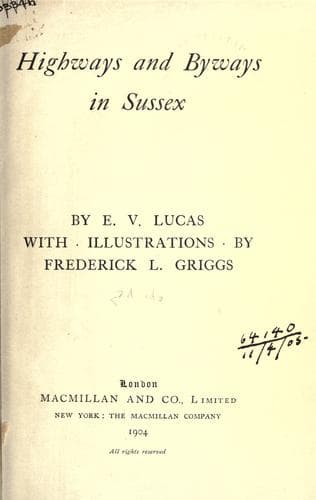
Highways and Byways in SussexLucas, E. V. (Edward Verrall)
History
Highways and Byways in Sussex
Lucas, E. V. (Edward Verrall)
Sussex (England) -- Description and travel
With the Conquest new life came into the town, as into South Sussex
generally. The rule of the de Braoses, who dominated so much of the
country through which we have been passing, is here no more, the great
lord of this district being William de Warenne, who had claims upon
William the Conqueror, not only for services rendered in the Conquest
but as a son-in-law. When, therefore, the contest was over, some of the
richest prizes fell to Earl de Warenne. Among them was the township of
Lewes, whose situation so pleased the Earl that he decided to make his
home there. His first action, then, was to graft upon the existing
fortress a new stronghold, the remains of which still stand.
Ten years after the victory at Hastings the memory of the blood of the
sturdy Saxons whom he had hacked down at Battle began so to weigh upon
de Warenne's conscience that he set out with Gundrada upon an expiatory
pilgrimage to Rome. Sheltering on the way in the monastery of St. Per,
at Cluny, they were so hospitably received that on returning to Lewes
William and Gundrada built a Priory, partly as a form of gratitude, and
partly as a safeguard for the life to come. In 1078, it was formally
founded on a magnificent scale. Thus Lewes obtained her castle and her
priory, both now in ruins, in the one of which William de Warenne might
sin with a clear mind, knowing that just below him, on the edge of the
water-brooks, was (in the other) so tangible an expiation.
The date of the formation of the priory spoils the pleasant legend which
tells how Harold, only badly wounded, was carried hither from Battle,
and how, recovering, he lived quietly with the brothers until his
natural death some years later. A variant of the same story takes the
English king to a cell near St. John's-under-the-Castle, also in Lewes,
and establishes him there as an anchorite. But (although, as we shall
see when we come to Battle, the facts were otherwise) all true
Englishmen prefer to think of Harold fighting in the midst of his army,
killed by a chance arrow shot into the zenith, and lying there until the
eyes of Editha of the Swan-neck lighted upon his dear corpse amid the
hundreds of the slain.
[Sidenote: THE CASTLE'S CURIOSITIES]
Public-domain text, read in full here on John Shaqi.
Reviews
Reviews
No reviews yet
Be the first to share your thoughts on this work.
Elsewhere in the archive
Join the Discussion
Join the discussion
Sign in to leave a comment or review.
Sign InorCreate an account