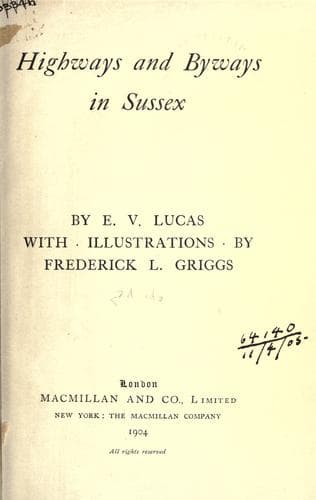
Highways and Byways in SussexLucas, E. V. (Edward Verrall)
History
Highways and Byways in Sussex
Lucas, E. V. (Edward Verrall)
Sussex (England) -- Description and travel
Looking down and around from the roof of the keep, you are immediately
struck by the wide shallow hollow in which Lewes lies. It is something
the shape of a dairy basin, the gap to the north-west, between Malling
Hill and Offham, serving for the lip. Nothing could be flatter than the
smiling meadows, streaked with tiny streams, stretching between Lewes
and the coast line to the south-east (with the exception of one
symmetrical hillock just out of the town). Among them curls the lazy
Ouse; just beneath you Lewes sleeps, red-roofed as an Italian town,
sending up no hum of activity, listless and immovable save for a few
spirals of silent smoke. The surrounding hills are very fine: Firle
Beacon in the far east; Mount Caburn, a noble cone, in the near east;
Mount Harry to the west, on whose slopes Henry III., assisted by the
fiery Prince Edward, fought the Barons. So fiery, indeed, was this lad
that he forgot all about his father, and gave chase to a small
detachment of the enemy, catching them up, and hewing them down with the
keenest enjoyment, while the unhappy Henry was being completely worsted
by de Montfort. It was a bloody battle, made up, as old Fabian wrote, of
embittered men, with hearts full of hatred, "eyther desyrous to bring
the other out of lyfe." Great fun was made by the humorists of the time,
after the battle, over the fact that Richard, King of the Romans,
Henry's brother, was captured in a windmill in which he had taken
refuge. This mill stood near the site of the Black Horse inn. In _The
Barons' Wars_, by Mr. Blaauw, the Sussex antiquary, the whole story is
told.
Lewes has played but a small part in history since that battle; but, as
we saw when we were at Rottingdean, it was one of her Cluniac priors
that repulsed the French in 1377, and her son, Sir Nicholas Pelham, who
performed a similar service in 1545, at Seaford. As the verses on his
monument in St. Michael's Church run:--
What time the French sought to have sackt Sea-Foord,
This Pelham did repel-em back aboord.
[Illustration: _Ann of Cleves' House, Southover._]
[Sidenote: THE CLUNIAC PRIORY]
The Cluniac priory of St. Pancras was dissolved by Henry VIII. in 1537,
Thomas Cromwell, that execrable vandal, not only abolishing the monks
but destroying the buildings, which covered, with their gardens and fish
ponds, forty acres. The ruins that remain give some idea of the extent
of this wonderful priory, another relic being the adjacent mound on
which the Calvary stood, probably constructed of the earth removed for
the purpose from the Dripping Pan, as the hollow circular space is
called where Lewes now plays cricket. One very pretty possession of the
monks was allowed to stand until quite recent times--the Columbarium,
which was as large as a church and contained homes for 3,228 birds. It
has now vanished; but an idea of what it was may be gained from the
pigeon house at Alciston, a few miles distant, which belonged to Battle
Abbey.
Public-domain text, read in full here on John Shaqi.
Reviews
Reviews
No reviews yet
Be the first to share your thoughts on this work.
Elsewhere in the archive
Join the Discussion
Join the discussion
Sign in to leave a comment or review.
Sign InorCreate an account