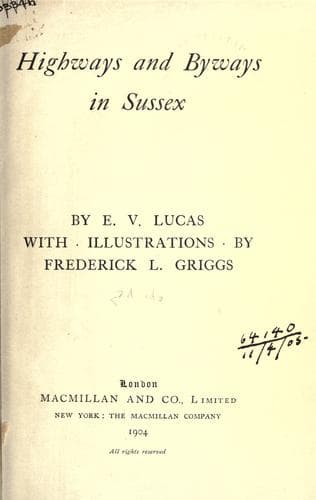
Highways and Byways in SussexLucas, E. V. (Edward Verrall)
History
Highways and Byways in Sussex
Lucas, E. V. (Edward Verrall)
Sussex (England) -- Description and travel
The priory's possessions were granted to Cromwell by Henry VIII., who,
tradition asserts (somewhat directly in the face of historical
evidence), murdered one of his wives on a winding stair in the building,
and may therefore have been glad to see its demolition. Which wife it
was, is not stated, but when Cromwell went the way of all this king's
favourites, the property was transferred to Ann of Cleves, who is
supposed to have lived in the most picturesque of the old houses on the
right hand side of Southover's street as you leave Lewes for the Ouse
valley.
Southover church, in itself a beautiful structure of the grave red type,
with a square ivied tower and the most delicate vane in Sussex, is
rendered the more interesting by the possession of the leaden caskets of
William de Warenne and Gundrada and the superb tomb removed from Isfield
church and very ingeniously restored. These relics repose in a charming
little chapel built in their honour.
[Sidenote: TOM PAINE]
A notable man who had association with Lewes was Tom Paine, author of
_The Rights of Man_. He settled there as an exciseman in 1768, married
Elizabeth Ollive of the same town at St. Michael's Church in 1771, and
succeeded to her father's business as a tobacconist and grocer. Paine
was more successful as a debater than a business man. As a member of the
White Hart evening club he was more often than any other the winner of
the Headstrong Book--an old Greek Homer despatched the next morning to
the most obstinate haranguer of the preceding night. It was at Lewes
that Tom Paine's thoughts were first turned to the question of
government. He used thus to tell the story. One evening after playing
bowls, all the party retired to drink punch; when, in the conversation
that ensued, Mr. Verril (it should be Verrall) "observed, alluding to
the wars of Frederick, that the King of Prussia was the best fellow in
the world for a king, he had so much of the devil in him. This, striking
me with great force, occasioned the reflection, that if it were
necessary for a king to have so much of the devil in him, kings might
very beneficially be dispensed with."
I thought of that historic game of bowls as I watched four Lewes
gentlemen playing this otherwise discreetest of games in the meadow by
the castle gate on a fine September evening. Surely (after the historic
Plymouth Hoe) a lawn in the shadow of a Norman castle is the ideal spot
for this leisurely but exciting pastime. The four Lewes gentlemen played
uncommonly well, with bowls of peculiar splendour in which a setting of
silver glistened as they sped over the turf. After each game one little
boy bearing a cloth wiped the bowls while another registered the score.
And now I feel that no one can really be said to have seen Lewes unless
he has watched the progress of such a game: it remains in my mind as
intimate a part of the town and the town's spirit as the ruins of the
Priory, or Keere Street, or the Castle itself.
Public-domain text, read in full here on John Shaqi.
Reviews
Reviews
No reviews yet
Be the first to share your thoughts on this work.
Elsewhere in the archive
Join the Discussion
Join the discussion
Sign in to leave a comment or review.
Sign InorCreate an account