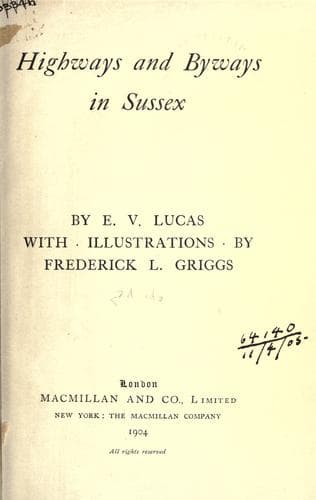
Highways and Byways in SussexLucas, E. V. (Edward Verrall)
History
Highways and Byways in Sussex
Lucas, E. V. (Edward Verrall)
Sussex (England) -- Description and travel
A well-behaved castle--Rail and romance--Britons, Romans, Saxons and
Normans at Pevensey--William the Conqueror--A series of sieges--The
first English letter--Andrew Borde, the jester, again--Pevensey
gibes--A red brick castle--Hurstmonceux church--The tomb of the
Dacres.--Two Hurstmonceux clerics--The de Fiennes and the de
Monceux--A spacious home--The ghost--The unfortunate Lord
Dacre--Horace Walpole at Hurstmonceux--The trug industry.
Pevensey Castle behaves as a castle should: it rises from the plain, the
only considerable eminence for miles; it has noble grey walls of the
true romantic hue and thickness; it can be seen from the sea, over which
it once kept guard; it has a history rich in assailants and defenders.
There is indeed nothing in its disfavour except the proximity of the
railway, which has been allowed to pass nearer the ruin than dramatic
fitness would dictate. Let it, however, be remembered that the railway
through the St. Pancras Priory at Lewes led to the discovery of the
coffins of William de Warenne and Gundrada, and also that, in Mr.
Kipling's phrase, romance, so far from being at enmity with the iron
horse, "brought up the 9.15."
[Illustration: _Pevensey Castle._]
Pevensey, which is now divided from the channel by marshy fields with
nothing to break the flatness but Martello towers (thirteen may be
counted from the walls), was, like Bramber Castle in the west, now also
an inland stronghold, once washed and surrounded by the sea. The sea
probably covered all the ground as far inland as Hailsham--Pevensey,
Horseye, Rickney and the other "eyes" on the level, being then
islands, as their termination suggests.
There is now no doubt but that Pevensey was the Anderida of the Romans,
a city on the borders of the great forest of Anderida that covered the
Weald of Sussex--Andreas Weald as it was called by the Saxons. But
before the Romans a British stronghold existed here. This, after the
Romans left, was attacked by the Saxons, who slew every Briton that they
found therein. The Saxons in their turn being discomfited, the Normans
built a new castle within the old walls, with Robert de Moreton, half
brother of the Conqueror, for its lord. Thus the castle as it now stands
is in its outer walls Roman, in its inner, Norman.
[Sidenote: WILLIAM'S LANDING]
Public-domain text, read in full here on John Shaqi.
Reviews
Reviews
No reviews yet
Be the first to share your thoughts on this work.
Elsewhere in the archive
Join the Discussion
Join the discussion
Sign in to leave a comment or review.
Sign InorCreate an account