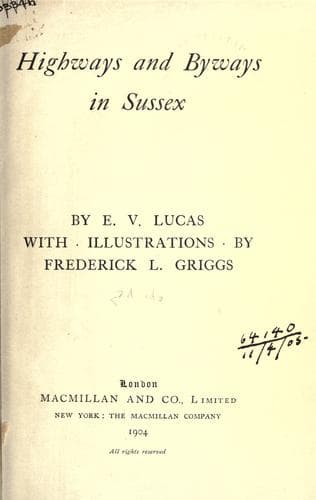
Highways and Byways in SussexLucas, E. V. (Edward Verrall)
History
Highways and Byways in Sussex
Lucas, E. V. (Edward Verrall)
Sussex (England) -- Description and travel
Unlike certain other Sussex fortresses, Pevensey has seen work. Of its
Roman career we know nothing, except that the inhabitants seem to have
dropped a large number of coins, many of which have been dug up. The
Saxons, as we have seen, massacred the Britons at Anderida very
thoroughly. Later, in 1042, Swane, son of Earl Godwin, swooped on
Pevensey's port in the Danish manner and carried off a number of ships.
In 1049 Earl Godwin, and another son, Harold, made a second foray,
carried off more ships, and fired the town. On September 28, 1066,
Pevensey saw a more momentous landing, destined to be fatal to this
marauding Harold; for on that day William, Duke of Normandy, soon to
become William the Conqueror, alighted from his vessel, accompanied by
several hundred Frenchmen in black chain armour. A representation of the
landing is one of the designs in the Bayeux tapestry. The embroiderers
take no count of William's fall as he stepped ashore, on ground now
grazed upon by cattle, an accident deemed unlucky until his ready wit
explained, as he rose with sanded fingers, "See, I have seized the land
with my hands."
Pevensey's later history included sieges by William Rufus in 1088, when
Odo, Bishop of Bayeux, supporter of Robert, was the defender; by
Stephen in 1144, the fortress being held by Maude, who gave in
eventually to famine; by Simon de Montfort and the Barons in 1265; and
by the supporters of Richard of York in 1399, when Lady Pelham defended
it for the Rose of Lancaster. A little later Edmund, Duke of York, was
imprisoned in it, and was so satisfied with his gaoler that he
bequeathed him _£_20. Queen Joan of Navarre, wife of Henry IV., was also a
prisoner here for nine years. In the year before the Armada, Pevensey
Castle was ordered to be either rebuilt as a fortress or razed to the
ground; but fortunately neither instruction was carried out.
The present owner of Pevensey Castle is the Duke of Devonshire, who by
virtue of the possession is entitled to call himself Dominus Aquilæ, or
Lord of the Eagle.
[Sidenote: LETTER-WRITING]
Pevensey has another and gentler claim to notice. Many essayists have
said pleasant and ingenious things about the art of letter-writing; but
none of them mentions the part played by Pevensey in the English
development of that agreeable accomplishment. Yet the earliest specimen
of English letter-writing that exists was penned in Pevensey Castle. The
writer was Joan Crownall, Lady Pelham, wife of Sir John Pelham, who, as
I have said, defended the castle, in her Lord's absence, against the
Yorkists, and this is the letter, penned (I write in 1903) five hundred
and four years ago. (It has no postscript.)
Public-domain text, read in full here on John Shaqi.
Reviews
Reviews
No reviews yet
Be the first to share your thoughts on this work.
Elsewhere in the archive
Join the Discussion
Join the discussion
Sign in to leave a comment or review.
Sign InorCreate an account