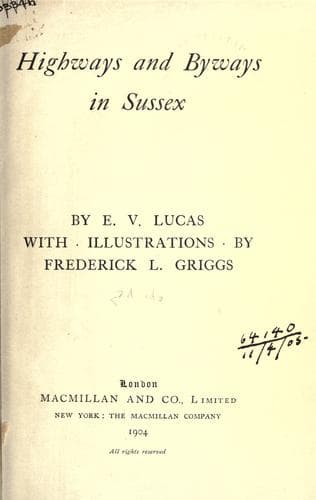
Highways and Byways in SussexLucas, E. V. (Edward Verrall)
History
Highways and Byways in Sussex
Lucas, E. V. (Edward Verrall)
Sussex (England) -- Description and travel
Fuller writes in the _Worthies_, concerning the wonders of
Sussex:--"Expect not here I should insert what _William_ of _Newbury_
writeth (to be recounted rather amongst the _Untruths_ than _Wonders_);
viz. 'That in this County, not far from Battail-Abby, in the Place
where so great a slaughter of the Englishmen was made, after any shower,
presently sweateth forth very fresh blood out of the Earth, as if the
evidence thereof did plainly declare the voice of Bloud there shed, and
crieth still from the Earth unto the Lord.' This is as true, as that in
_white_ chalky Countries (about Baldock in Hertfordshire) after rain run
rivolets of _Milk_; Neither being anything else than the Water
discoloured, according to the _Complexion_ of the Earth thereabouts."
[Illustration: _Mount Street, Battle._]
The Conqueror was true to his vow, and the Abbey of St. Martin was
quickly begun. At first there was difficulty about the stone, which was
brought all the way from Caen quarries, until, according to an old
writer, a pious matron dreamed that stone in large quantities was to be
found near at hand. Her vision leading to the discovery of a
neighbouring quarry, the work proceeded henceforward with exceeding
rapidity.
[Sidenote: ST. MARTIN'S ABBEY]
Although the first Abbot was appointed in 1076, William the Conqueror
did not live to see the Abbey finished. Sixty monks of the Order of St.
Benedict came to Battle from the Abbey of Marmontier in Normandy, to
form its nucleus. It was left to William Rufus to preside over the
consecration of Battle, which was not until February, 1095, when the
ceremony was performed amid much pomp. William presented to the Abbey
his father's coronation robe and the sword he had wielded in the battle.
Several wealthy manors were attached and the country round was exempted
from tax; while the Abbots were made superior to episcopal control, and
were endowed with the right to sit in Parliament and a London house to
live in during the session. Indeed nothing was left undone that could
minister to the pride and power of the new house of God.
The Abbey of St. Martin was quadrangular, standing in the midst of a
circle nine miles round. Within this were vineyards, stew ponds and rich
land. Just without was a small street of artisans' dwellings, where were
manufactured all things requisite for the monks' material well-being.
The church was the largest in the country, larger even than Canterbury.
It was also a sanctuary, any sentenced criminal who succeeded in
sheltering therein receiving absolution from the Abbot. The high altar,
as I have said, was erected precisely on the spot where Harold fell: a
spot on which one may now stand and think of the past.
Public-domain text, read in full here on John Shaqi.
Reviews
Reviews
No reviews yet
Be the first to share your thoughts on this work.
Elsewhere in the archive
Join the Discussion
Join the discussion
Sign in to leave a comment or review.
Sign InorCreate an account