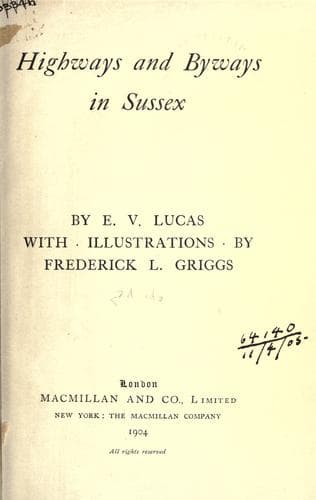
Highways and Byways in SussexLucas, E. V. (Edward Verrall)
History
Highways and Byways in Sussex
Lucas, E. V. (Edward Verrall)
Sussex (England) -- Description and travel
Battle Abbey was more than once visited by kings. In 1200 John was
there, shaking like a quicksand. He brought a piece of our Lord's
sepulchre, which had been wrested from Palestine by Richard the Lion
Heart, and laid it with tremulous hands on the altar, hoping that the
magnificence of the gift might close Heaven's eyes towards sins of his
own. In 1212, he was at Battle Abbey again, and for the last time in
1213, seeking, maybe, to find in these silent cloisters some
forgetfulness of the mutterings of hate and scorn that everywhere
followed him.
[Sidenote: KINGS AT BATTLE]
Just before the Battle of Lewes, Henry III. galloped up, attended by a
body-guard of overbearing horsemen, and levied large sums of money to
assist him in the struggle. After the battle he returned, a weary
refugee, but still rapacious.
These visits were not welcome. It was different when Edward II. slept
there on the night of August 28th, 1324. Alan de Ketbury, the Abbot, was
bent on showing loyalty at all cost, while the neighbouring lords and
squires were hardly less eager. The Abbot's contribution to the kitchen
included twenty score and four loaves of bread, two swans, two rabbits,
three fessantes, and a dozen capons; William de Echingham sent three
peacocks, twelve bream, six muttons, and other delicacies; and Robert
Acheland four rabbits, six swans, and three herons.
In 1331, Abbot Hamo and his monks kept at bay a body of French
marauders, who had landed at Rye, until the country gentlemen could
assemble and repulse them utterly.
Then followed two peaceful centuries; but afterwards came disaster, for,
in 1558, Thomas Cromwell sent down two commissioners to examine into the
state of the Abbey and report thereon to the zealous Defender of the
Faith. The Commissioners found nineteen books in the library, and
rumours of monkish debauchery without the walls. "So beggary a house,"
wrote one of the officers, "I never see." Battle Abbey was therefore
suppressed and presented to Sir Anthony Browne, upon whom, as we saw in
the first chapter, the "Curse of Cowdray" was pronounced by the last
departing monk.
Public-domain text, read in full here on John Shaqi.
Reviews
Reviews
No reviews yet
Be the first to share your thoughts on this work.
Elsewhere in the archive
Join the Discussion
Join the discussion
Sign in to leave a comment or review.
Sign InorCreate an account