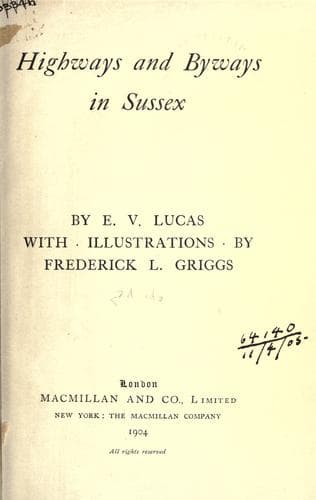
Highways and Byways in SussexLucas, E. V. (Edward Verrall)
History
Highways and Byways in Sussex
Lucas, E. V. (Edward Verrall)
Sussex (England) -- Description and travel
To catalogue the present features of Battle Abbey is to vulgarise it.
One comes away with confused memories of grey walls embraced by white
clematis and red rose; gloomy underground caverns with double rows of
arches, where the Brothers might not speak; benignant cedars blessing
the turf with extended hands; fragrant limes waving their delicate
leaves; an old rose garden with fantastic beds; a long yew walk where
the Brothers might meditatively pace--turning, perhaps, an epigram,
regretting, perhaps, the world. Nothing now remains of the Refectory,
where, of old, forty monks fed like one, except the walls. It once had a
noble roof of Irish oak, but that was taken to Cowdray and perished in
the fire there, together with the Abbey roll. One of the Abbey's first
charms is the appropriateness of its gardens; they too are old. In the
cloisters, for instance, there are wonderful box borders.
[Illustration: _Battle Abbey. The Refectory._]
[Sidenote: TURNER'S PICTURE]
Turner painted "Battle Abbey: the spot where Harold fell," with a
greyhound pressing hard upon a hare in the foreground, and a Scotch fir
Italianated into a golden bough.
The town of Battle has little interest. In the church is a brass to
Thomas Alfraye and his wife Elizabeth--Thomas Alfraye "whose soul"
according to his epitaph,
In active strength did passe
As nere was found his peere.
One would like to know more of this Samson. The tomb of Sir Anthony
Browne is also here; but it is not so imposing as that of his son, the
first Viscount Montagu, which we saw at Easebourne. In the churchyard is
the grave of Isaac Ingall, the oldest butler on record, who died at the
age of one hundred and twenty, after acting as butler at the Abbey for
ninety-five years.
From Battle one may reach easily Normanhurst, the seat of the Brasseys,
and Ashburnham Park, just to the north of it, a superb undulating
domain, with lakes, an imposing mansion, an old church, brake fern,
magnificent trees and a herd of deer, all within its confines. Of the
church, however, I can say nothing, for I was there on a very hot day,
the door was locked, and the key was at the vicarage, ten minutes'
distant, at the top of a hill. Churches that are thus controlled must be
neglected.
[Sidenote: ASHBURNHAM]
Ashburnham Place once contained some of the finest books in England and
is still famous for its relics of Charles I.; but strangers may not see
them. The best Sussex iron was smelted at Ashburnham Furnace, north of
the park, near Penhurst. Ashburnham Forge was the last to remain at work
in the county; its last surviving labourer of the neighbourhood died in
1883. He remembered the extinguishing of the fire in 1813 (or 1811), the
casting of fire-backs being the final task. Penhurst, by the way, is one
of the most curiously remote villages in east Sussex, with the oddest
little church.
Public-domain text, read in full here on John Shaqi.
Reviews
Reviews
No reviews yet
Be the first to share your thoughts on this work.
Elsewhere in the archive
Join the Discussion
Join the discussion
Sign in to leave a comment or review.
Sign InorCreate an account