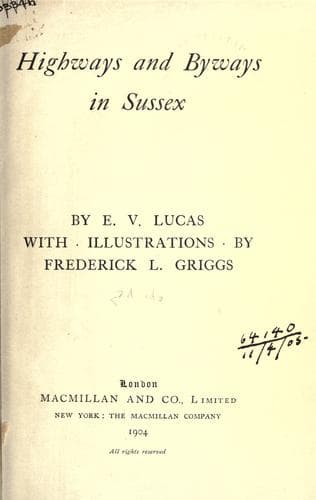
Highways and Byways in SussexLucas, E. V. (Edward Verrall)
History
Highways and Byways in Sussex
Lucas, E. V. (Edward Verrall)
Sussex (England) -- Description and travel
Rye stands where it always stood: but the original Winchelsea is no
more. It was built two miles south-south-east of Rye, on a spot since
covered by the sea but now again dry land. At Old Winchelsea William the
Conqueror landed in 1067 after a visit to Normandy; in 1138 Henry II.
landed there, while the French landed often, sometimes disastrously and
sometimes not. In those days Winchelsea had seven hundred householders
and fifty inns. In 1250, however, began her downfall. Holinshed
writes:--"On the first day of October (1250), the moon, upon her change,
appearing exceeding red and swelled, began to show tokens of the great
tempest of wind that followed, which was so huge and mightie, both by
land and sea, that the like had not been lightlie knowne, and seldome,
or rather never heard of by men then alive. The sea forced contrarie to
his natural course, flowed twice without ebbing, yeelding such a rooring
that the same was heard (not without great woonder) a farre distance
from the shore. Moreover, the same sea appeared in the darke of the
night to burne, as it had been on fire, and the waves to strive and
fight togither after a marvellous sort, so that the mariners could not
devise how to save their ships where they laie at anchor, by no cunning
or shift which they could devise. At Hert-burne three tall-ships
perished without recoverie, besides other smaller vessels. At
Winchelsey, besides other hurte that was doone, in bridges, milles,
breakes, and banks, there were 300 houses and some churches drowned with
the high rising of the water course."
[Sidenote: WINCHELSEA'S VICISSITUDES]
The Winchelsea people, however, did not abandon their town. In 1264
Henry III. was there on his way to the Battle of Lewes, and later,
Eleanor, wife of Henry's conqueror, de Montfort, was there too, and
encouraged by her kindness to them the Winchelsea men took to active sea
piracy, which de Montfort encouraged. In 1266, however, Prince Edward,
who disliked piracy, descended upon the town and chastised it bloodily;
while on February 4, 1287, a greater punishment came, for during another
storm the town was practically drowned, all the flat land between Pett
and Hythe being inundated. New Winchelsea, the Winchelsea of to-day, was
forthwith begun under royal patronage on a rock near Icklesham, the
north and east sides of which were washed by the sea. A castle was set
there, and gates, of which three still stand--Pipewell, Strand and
New--rose from the earth. The Grey Friars monastery and other religious
houses were reproduced as at Old Winchelsea, and a prosperous town
quickly existed.
Public-domain text, read in full here on John Shaqi.
Reviews
Reviews
No reviews yet
Be the first to share your thoughts on this work.
Elsewhere in the archive
Join the Discussion
Join the discussion
Sign in to leave a comment or review.
Sign InorCreate an account