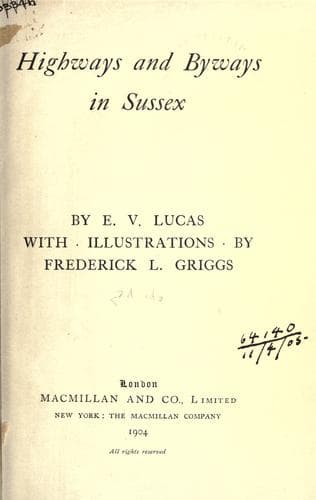
Highways and Byways in SussexLucas, E. V. (Edward Verrall)
History
Highways and Byways in Sussex
Lucas, E. V. (Edward Verrall)
Sussex (England) -- Description and travel
Eridge, whither all visitors to Tunbridge Wells must at one time or
another drive, is the seat of the Marquis of Abergavenny, whose imposing
A, tied, like a dressing gown, with heavy tassels, is embossed on every
cottage for miles around. In character the park resembles Ashburnham,
while in extent it vies with the great parks of the south-west, Arundel,
Goodwood and Petworth; but it has none of their spacious coolnesses. Yet
Eridge Park has joys that these others know not of--brake fern four feet
high, and the conical hill on which stands Saxonbury Tower, jealously
guarded from the intruding traveller by the stern fiat of "Mr. Macbean,
steward." Sussex is a paradise of notice boards (there is a little
district near Forest Row where the staple industry must be the
prosecuting of trespassers), and one has come ordinarily to look upon
these monitions without active resentment; but when the Caledonian
descends from his native heath to warn the Sussex man off Sussex
ground--more, to warn the Saxon from his own bury--the situation becomes
acute. By taking, however, the precaution of asking at a not too
adjacent cottage for permission to ascend the hill, one may circumvent
the Scottish prosecutor.
The hill is very important ground in English history, as the following
passage from Sir William Burrell's MSS. in the British Museum
testifies:--"In Eridge Park are the remains of a military station of the
Saxon invaders of the country, which still retains the name of Saxonbury
Hill. It is on the high ground to the right, as the traveller passes
from Frant to Mayfield. On the summit of this hill (from whence the
cliffs of Dover may be seen) are to be traced the remains of an ancient
fortification; the fosse is still plainly discernible, enclosing an area
of about two acres, from whence there is but one outlet. The apex of the
hill within is formed of a strong compact body of stone, brought hither
from a distance, on which doubtless was erected some strong military
edifice. This was probably one of the stations occupied by the Saxons
under Ella, their famous chief, who, at the instance of Hengist, King of
Kent, invaded England towards the close of the fifth century. It is said
that they settled in Sussex, whence they issued in force to attack the
important British station of Anderida or Andredceaster. Antiquaries are
not agreed as to the precise situation of this military station; some
imagining it to have been at Newenden, on the borders of Kent; others at
Pevensey, or Hastings, in Sussex. The country, from the borders of Kent
to those of Hampshire, comprises what was called the Forest of
Andredsweald, now commonly called the Weald, was formerly full of strong
holds and fastnesses, and was consequently well calculated for the
retreat of the ancient Britons from before the regular armies of the
Romans, as well as for the establishment of points of attack by the
succeeding invaders who coped with them on terms somewhat reversed. The
Public-domain text, read in full here on John Shaqi.
Reviews
Reviews
No reviews yet
Be the first to share your thoughts on this work.
Elsewhere in the archive
Join the Discussion
Join the discussion
Sign in to leave a comment or review.
Sign InorCreate an account