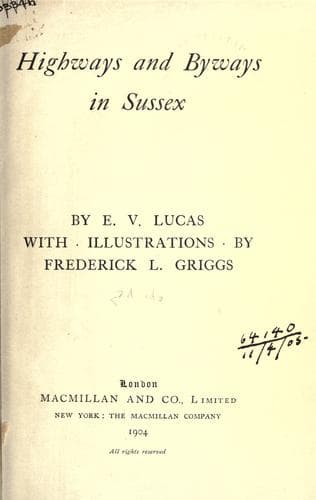
Highways and Byways in SussexLucas, E. V. (Edward Verrall)
History
Highways and Byways in Sussex
Lucas, E. V. (Edward Verrall)
Sussex (England) -- Description and travel
attack of the Saxons on Anderida was successful, and the consequence was
their permanent establishment in Sussex and Surrey, from which time they
probably retained a military station on this hill.
"There is likewise within the park a place called Danes Gate. This was
doubtless a part of a military way; and as it would happen that the last
successful invaders would occupy the same strong posts which had been
formed by their predecessors, this Danes Gate was probably the military
communication between Crowborough, undoubtedly a Danish station, and
Saxonbury Hill."
The view from Saxonbury extends far in each quarter, embracing both
lines of Downs, North and South. The long low irregular front of Eridge
Castle is two or three miles to the north-west, with its lake before it.
[Sidenote: LORD NORTH'S DISCOVERY]
Queen Elizabeth stayed at Eridge for six days in 1573, on her progress
to Northiam, where we saw her dining and changing her shoes. Lord
Burleigh, who accompanied her, found the country hereabouts dangerous,
and "worse than in the Peak." It was another of the guests at Eridge
that made Tunbridge Wells; for had not Dudley, Lord North, when
recuperating there in 1606, discovered that the (Devil-flavoured)
chalybeate water of the neighbourhood was beneficial, the spring would
not have been enclosed nor would other of London's fatigued young bloods
have drunk of it.
[Illustration: _Bayham Abbey._]
[Sidenote: BAYHAM ABBEY]
Enough remains of Bayham Abbey, five miles south-east of Tunbridge
Wells, to show that it was once a very considerable monastery. The
founder was Sir Robert de Turneham, one of the knights of Richard
Coeur de Lion, famous for cracking many crowns with his "fauchion,"
and the founder also of Combwell Abbey at Goudhurst, not far distant.
Edward I. and Edward II. were both entertained at Bayham, while a
fortunate visit from St. Richard, Bishop of Chichester, put the Abbey in
possession of a bed (on which he had slept) which cured all them that
afterwards lay in it. Between Bayham and Goudhurst is Lamberhurst, on
the boundary. (The church and part of the street are indeed in Kent.)
Lamberhurst's boast is that its furnaces were larger than any in Sussex;
and that they made the biggest guns. The old iron railings around St.
Paul's are said to have come from the Lamberhurst iron works--2,500 in
all, each five feet six inches in height, with seven gates. The
Lamberhurst cannon not only served England, but some, it is whispered,
found their way to French privateers and were turned against their
native land.
Public-domain text, read in full here on John Shaqi.
Reviews
Reviews
No reviews yet
Be the first to share your thoughts on this work.
Elsewhere in the archive
Join the Discussion
Join the discussion
Sign in to leave a comment or review.
Sign InorCreate an account