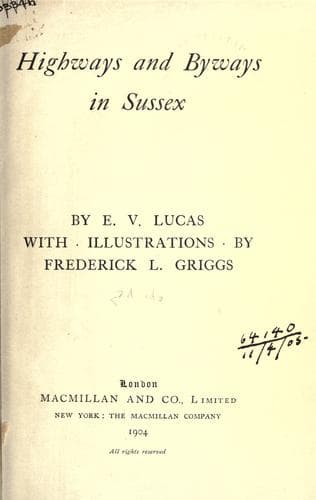
Highways and Byways in SussexLucas, E. V. (Edward Verrall)
History
Highways and Byways in Sussex
Lucas, E. V. (Edward Verrall)
Sussex (England) -- Description and travel
And here we leave the county.
CHAPTER XLI
THE SUSSEX DIALECT
French words at Hastings and Rye--Saxon on the farms--Mr. W. D.
Parish's _Dictionary of the Sussex Dialect_--The rules of the
game--The raciest of the words--A Sussex criticism of Disraeli--The
gender of a Sussex nose--A shepherd's adventures--Sussex words in
America--"The Song of Solomon" in the Sussex vernacular.
The body of the Sussex dialect is derived from the Saxon. Its
accessories can be traced to the Celts, to the Norse--thus _rape_, a
division of the county, is probably an adaptation of the Icelandic
_hreppr_--and to the French, some hundreds of Huguenots having fled to
our shores after the Edict of Nantes. The Hastings fishermen, for
example, often say _boco_ for plenty, and _frap_ to strike; while in the
Rye neighbourhood, where the Huguenots were strongest, such words as
_dishabil_ meaning untidy, undressed, and _peter grievous_ (from
_petit-grief_) meaning fretful, are still used.
But Saxon words are, of course, considerably more common. You meet them
at every turn. A Sussex auctioneer's list that lies before me--a
catalogue of live and dead farming stock to be sold at a homestead under
the South Downs--is full of them. So blunt and sturdy they are, these
ancient primitive terms of the soil: "Lot 1. Pitch prong, two half-pitch
prongs, two 4-speen spuds, and a road hoe. Lot 5. Five short prongs,
flint spud, dung drag, two turnip pecks, and two shovels. Lot 9. Six hay
rakes, two scythes and sneaths, cross-cut saw, and a sheep hook. Lot 39.
Corn chest, open tub, milking stool, and hog form. Lot 43. Bushel
measure, shaul and strike. Lot 100. Rick borer. Lot 143. Eight knaves
and seven felloes. Lot 148. Six dirt boards and pair of wood hames. Lot
152. Wheelwright's sampson. Lot 174. Set of thill harness. Lot 201.
Three plough bolts, three tween sticks. Lot 204. Sundry harness and
whippances. Lot 208. Tickle plough. Lot 222. Iron turnwrist [pronounced
turn-riced] plough. Lot 242. 9-time scarifier. Lot 251. Clod crusher.
Lot 252. Hay tedder." From another catalogue more ram=alogues, these
abrupt and active little words might be called, butt at one. As "Lot 4.
Flint spud, two drain scoops, bull lead and five dibbles. Lot 10. Dung
rake and dung devil. Lot 11. Four juts and a zinc skip." Farm labourers
are men of little speech, and it is often needful that voices should
carry far. Hence this crisp and forcible reticence. The vocabulary of
the country-side undergoes few changes; and the noises to-day made by
the ox-herd who urges his black and smoking team along the hill-side are
precisely those that Piers Plowman himself would have used.
[Sidenote: SAXON PERSISTENT]
Another survival may be noticed in objurgation. A Sussex man swearing by
Job, as he often does, is not calling in the aid of the patient sufferer
of Uz, but Jobe, the Anglo-Saxon Jupiter.
Public-domain text, read in full here on John Shaqi.
Reviews
Reviews
No reviews yet
Be the first to share your thoughts on this work.
Elsewhere in the archive
Join the Discussion
Join the discussion
Sign in to leave a comment or review.
Sign InorCreate an account