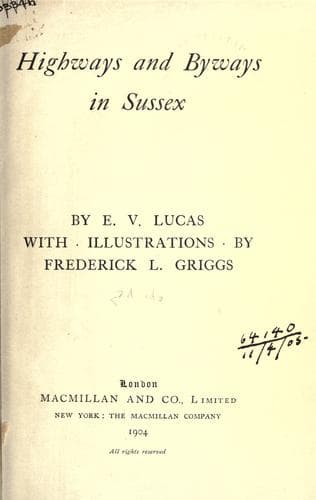
Highways and Byways in SussexLucas, E. V. (Edward Verrall)
History
Highways and Byways in Sussex
Lucas, E. V. (Edward Verrall)
Sussex (England) -- Description and travel
A few examples of Sussex speech, mainly drawn from Mr. Parish's
_Dictionary of the Sussex Dialect_ will help to add the true flavour to
these pages. Mr. Parish's little book is one of the best of its kind;
that it is more than a contribution to etymology a very few quotations
will show.
[Sidenote: THE SUSSEX RULES]
Mr. Parish lays down the following general principles of the Sussex
tongue:--
_a_ before double _d_ becomes _ar_; whereby ladder and adder are
pronounced larder and arder.
_a_ before double _l_ is pronounced like _o_; fallow and tallow become
foller and toller.
_a_ before _t_ is expanded into _ea_; rate, mate, plate, gate, are
pronounced rėȧt, mėȧt, plėȧt, gėȧt.
_a_ before _ct_ becomes _e_; as satisfection, for satisfaction.
_e_ before _ct_ becomes _a_; and affection, effect and neglect are
pronounced affaction, effact and neglact.
Double _e_ is pronounced as _i_ in such words as sheep, week, called
ship and wick; and the sound of double _e_ follows the same rule in fild
for field.
Having pronounced _ee_ as _i_, the Sussex people in the most impartial
manner pronounce _i_ as _ee_; and thus mice, hive, dive, become meece,
heeve, and deeve.
_i_ becomes _e_ in pet for pit, spet for spit, and similar words.
_io_ and _oi_ change places respectively; and violet and violent become
voilet and voilent, while boiled and spoiled are bioled and spioled.
_o_ before _n_ is expanded into _oa_ in such words as pony, dont, bone;
which are pronounced pȯȧny, dȯȧnt, bȯȧn.
_o_ before _r_ is pronounced as _a_; as carn and marning, for corn and
morning.
_o_ also becomes _a_ in such words as rad, crass, and crap, for rod,
cross, and crop.
_ou_ is elongated into _aou_ in words like hound, pound, and mound;
pronounced haound, paound, and maound.
The final _ow_, as in many other counties, is pronounced er, as foller
for fallow.
The peculiarities with regard to the pronunciation of consonants are not
so numerous as those of the vowels, but they are very decided, and seem
to admit of less variation.
Double _t_ is always pronounced as _d_; as liddle for little, &c., and
the _th_ is invariably _d_; thus the becomes _de_; and these, them,
theirs--dese, dem, deres.
_d_ in its turn is occasionally changed into _th_; as in fother for
fodder.
The final _sp_ in such words as wasp, clasp, and hasp are reversed to
wapse, clapse and hapse.
Words ending in _st_ have the addition of a syllable in the possessive
case and the plural, and instead of saying that "some little birds had
built their nests near the posts of Mr. West's gate," a Sussex boy would
say, "the birds had built their nestes near the postes of Mr. Westes'
gate."
[Sidenote: EAST AND WEST]
Public-domain text, read in full here on John Shaqi.
Reviews
Reviews
No reviews yet
Be the first to share your thoughts on this work.
Elsewhere in the archive
Join the Discussion
Join the discussion
Sign in to leave a comment or review.
Sign InorCreate an account