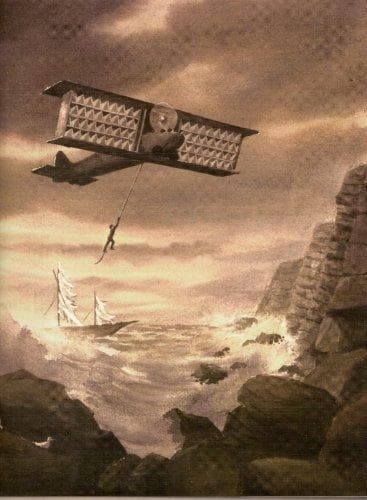
Jack Adeler was the son of a quiet old gentleman who had left him
five hundred thousand dollars, a ranch in Mexico, and the kindliest
disposition that a man ever had. He had graduated from Yale, then
entered the army, and was devoting a great deal of his own private
fortune to aviation. He had never made such showy flights as had
Captain Welch, and he never advertised his knowledge of aviation as
did the Captain, but Hike had the feeling that he really knew about
ten times as much about it. He was solidly built and quick and quiet,
and he liked to have Hike and Poodle with him, and never was tired of
answering their questions.
When they found him—playing golf on the Post links—he listened to
their tale of Martin Priest and the tetrahedral. He said that he too
was a little afraid that Priest was a crank; but he promised to ride
down the coast with the boys and look over the machine.
They started the next day.
When they reached the secret valley beyond Canyon Diablo, the crank
aviator was sitting on a soap-box, waiting for them. He had cut his
hair, in a rough way, and had changed his crazy-looking white gown
for overalls, a blue flannel shirt, and a greasy sweater-jacket.
Poodle’s opinion was that he had changed himself from a crazy prophet
into a tramp, a hobo mechanic; but both Hike and Lieutenant Adeler
said that he looked like an Edison, with his broad forehead, slender
hands, and bright eyes.
“Well, I wish I could find out all them things, like you high-brows,”
sighed Poodle. “I admit that I’m a mutt. I ain’t even sure but what
I’m a wutt. So I hope you’ll let me go to sleep on that nice soft
grass, and not yell ‘Come on’ too quick.”
Martin Priest seemed to have waked up. He spoke quickly and
hopefully—just as Hike did when he was interested. He showed them the
machine, and told them of the small flights he had taken with his
broken-down engine.
He explained a hundred devices. For instance, there was the speed
changing gear. His aeroplane was the only one that ran on several
speeds, like an automobile, so that the aviator could fly at
different rates without having to cut down the feed of the engine
with the hand-throttle, every second. But there was a hand-throttle,
too. Then, there were double control wires, running from the levers
to the rudder and the elevating planes, so that, if one wire broke (a
thing that has caused many an aviator’s death) another would take its
place.
For starting the machine from the seat—without having to have some
one whirl the propeller till the engine was going—there was an
electrical motor, which was a sort of boy of all work. For, when it
was through its work as a motor, it became a dynamo, and filled up
storage-batteries which worked the big electrical search-light, for
use when the machine was flying at night. It also ran a tiny electric
stove, placed at the side of the freight-platform, and warmed
electric heating-pads placed on the aviator’s seat to keep him warm.
Public-domain text, read in full here on John Shaqi.
Reviews
Reviews
No reviews yet
Be the first to share your thoughts on this work.
Join the Discussion
Join the discussion
Sign in to leave a comment or review.
Sign InorCreate an account