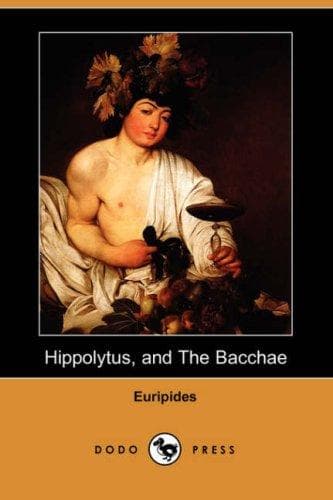
Euripides -- Translations into English; Mythology, Greek -- Drama
HIPPOLYTUS
Farewell, farewell, most Blessèd! Lift thee clear
Of soiling men! Thou wilt not grieve in heaven
For my long love! ...Father, thou art forgiven.
It was Her will. I am not wroth with thee...
I have obeyed Her all my days! ...
Ah me,
The dark is drawing down upon mine eyes;
It hath me! ... Father! ... Hold me! Help me rise!
THESEUS (_supporting him in his arms_)
Ah, woe! How dost thou torture me, my son!
HIPPOLYTUS
I see the Great Gates opening. I am gone.
THESEUS
Gone? And my hand red-reeking from this thing!
HIPPOLYTUS
Nay, nay; thou art assoiled of manslaying.
THESEUS
Thou leav'st me clear of murder? Sayst thou so?
HIPPOLYTUS
Yea, by the Virgin of the Stainless Bow!
THESEUS
Dear Son! Ah, now I see thy nobleness!
HIPPOLYTUS
Pray that a true-born child may fill my place.
THESEUS
Ah me, thy righteous and god-fearing heart!
HIPPOLYTUS
Farewell;
A long farewell, dear Father, ere we part!
[THESEUS _bends down and embraces him passionately_.]
THESEUS
Not yet!--O hope and bear while thou hast breath!
HIPPOLYTUS
Lo, I have borne my burden. This is death...
Quick, Father; lay the mantle on my face.
[THESEUS _covers his face with a mantle and rises._]
THESEUS
Ye bounds of Pallas and of Pelops' race,
What greatness have ye lost!
Woe, woe is me!
Thou Cyprian, long shall I remember thee!
CHORUS
On all this folk, both low and high,
A grief hath fallen beyond men's fears.
There cometh a throbbing of many tears,
A sound as of waters falling.
For when great men die,
A mighty name and a bitter cry
Rise up from a nation calling.
[_They move into the Castle, carrying the body of_ HIPPOLYTUS.]
THE BACCHAE
OF EURIPIDES
DRAMATIS PERSONAE
DIONYSUS, THE GOD; _son of Zeus and of the Theban princess Semelê_.
CADMUS, _formerly King of Thebes, father of Semelê_.
PENTHEUS, _King of Thebes, grandson of Cadmus_.
AGAVE, _daughter of Cadmus, mother of Pentheus_.
TEIRESIAS, _an aged Theban prophet_.
A SOLDIER OF PENTHEUS' GUARD.
TWO MESSENGERS.
A CHORUS OF INSPIRED DAMSELS, _following Dionysus from the East_.
_"The play was first produced after the death of Euripides by his son who
bore the same name, together with the Iphigenia in Aulis and the Alcmaeon,
probably in the year 405 B.C."_
_The background represents the front of the Castle of_ PENTHEUS, _King of
Thebes. At one side is visible the sacred Tomb of Semelê, a little
enclosure overgrown with wild vines, with a cleft in the rocky floor of it
from which there issues at times steam or smoke. The God_ DIONYSUS _is
discovered alone._
Public-domain text, read in full here on John Shaqi.
Reviews
Reviews
No reviews yet
Be the first to share your thoughts on this work.
Join the Discussion
Join the discussion
Sign in to leave a comment or review.
Sign InorCreate an account