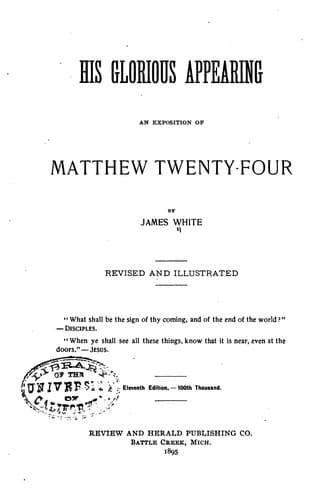
His Glorious Appearing: An Exposition of Matthew Twenty-FourWhite, James
Religion
His Glorious Appearing: An Exposition of Matthew Twenty-Four
White, James
Bible. Matthew, XXIV -- Commentaries; Second Advent
The world‐wide proclamation of the soon coming of Christ was inaugurated
about 1832. Since that time, the work of extending its warning voice has
gone on. A most remarkable feature of this movement is the fact that in
different countries individuals were moved upon, almost simultaneously, to
study the prophecies and proclaim the nearness of the end, although they
knew nothing of what was being done by others. In the United States and
Canada, in Great Britain, Norway, Sweden, Germany, and in Asia, a profound
interest in this subject was created, and people were led to expect the
early appearance of Jesus. Since that time clearer light has appeared in
connection with the other messages of Revelation 14, and still the work is
onward. Wherever the light of the Bible has penetrated, the good news of
the coming Saviour is now going. Not only so, but messengers bearing this
gracious warning are rapidly finding their way into the dark portions of
the earth. Evidence of its extent and progress might be expressed in facts
and figures, but the rapid development of the work would soon leave these
in the rear. Let it suffice to say that at present the everlasting gospel
is being preached and published in all the leading languages and countries
of the world. The work has encircled the globe. It is rapidly reaching
every nation. We now wait for the approaching end; for when the purpose of
God in the proclamation of the coming reign of Christ shall be fully
accomplished, then the end will come.
Thus far in this discourse Jesus has passed over the entire Christian
dispensation. Beginning with a warning against the deceptions that were to
succeed his own times, he next describes wars and disasters, persecutions,
apostasy, the perils of the last days, and closes with a distinct sign of
the end.
WHEN SHALL THESE THINGS BE?
VERSES 15‐20: “When ye, therefore, shall see the abomination of
desolation, spoken of by Daniel the prophet, stand in the holy
place (whoso readeth, let him understand); then let them which be
in Judea flee into the mountains; let him which is on the housetop
not come down to take anything out of his house; neither let him
which is in the field return back to take his clothes. And woe
unto them that are with child, and to them that give suck in those
days! But pray ye that your flight be not in the winter, neither
on the Sabbath day.”
Our Lord having in verses 5‐14, passed over the important events in the
Christian age down to the end, goes back and introduces in verse 15 the
destruction of Jerusalem, in answer to the inquiry, “When shall these
things be?” Luke’s version of this language is, “When ye shall see
Jerusalem encompassed with armies, then know that the desolation thereof
is nigh.” Luke 21:20. By this we know that the term “abomination of
desolation” refers to the Roman army. This desolating power is spoken of
by Daniel as follows:—
Public-domain text, read in full here on John Shaqi.
Reviews
Reviews
No reviews yet
Be the first to share your thoughts on this work.
Join the Discussion
Join the discussion
Sign in to leave a comment or review.
Sign InorCreate an account