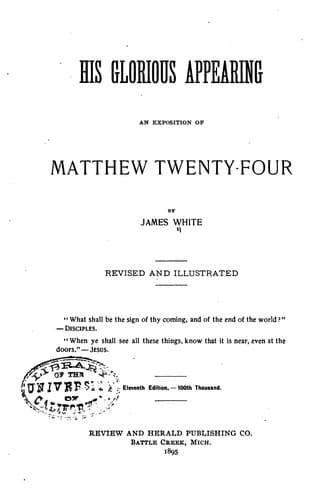
His Glorious Appearing: An Exposition of Matthew Twenty-FourWhite, James
Religion
His Glorious Appearing: An Exposition of Matthew Twenty-Four
White, James
Bible. Matthew, XXIV -- Commentaries; Second Advent
Jesus recognizes the existence of the Sabbath, in verse 20, as late as the
destruction of Jerusalem, as verily as he does the seasons of the year.
_The Sabbath_, is the uniform term of both Testaments to designate the
very day on which Jehovah rested after the creation, the day upon which he
put his blessing, and which he set apart for man. Not only in this
instance does our Saviour show his regard for the sacred day of rest, but
in his life he kept it (see Luke 4:16); in his teaching he upheld it, and
taught its true character (Matt. 12:12); and when he lay in the tomb, the
devout women reverently rested “according to the commandment.” He himself
is Lord of the Sabbath, and he declares that it was made for man. Mark
2:27, 28. Jesus does not speak of the Sabbath as being only a seventh part
of time, or one day in seven, and no day in particular. The Sabbath is the
term used, referring to the last day of the first week of time, and to the
last day of each subsequent week.
It is thus that Jesus answered the question, “When shall these things be?”
He now proceeds to answer the second great question.
WHAT SHALL BE THE SIGN OF THY COMING?
VERSE 21: “For then shall be great tribulation, such as was not
since the beginning of the world to this time, no, nor ever shall
be.”
It is not surprising, perhaps, that upon a casual reading some should
conclude that this verse had its fulfillment at the siege of Jerusalem by
Titus. It was a time of great suffering, and the verse follows so closely
those which relate to the destruction of the city, that this explanation
suggests itself readily enough. But for good reasons we cannot accept that
application of this verse. Jesus is giving a continuous prophecy. The
narrative proceeds from verse to verse along the line of the entire
dispensation.
The “great tribulation” mentioned in verse 21 is that of the church of
Christ, and not the tribulation of the Jews at the destruction of
Jerusalem. We offer the following reasons for so deciding:—
1. It is a fact that the tribulation of the Christian church, especially
under the reign of the papacy, was greater than God’s people had suffered
before “since the beginning of the world.” The tribulation of the
Christian church has been greater than it will ever be again. True, a time
of trouble “such as never was,” spoken of in Dan. 12:1, is coming _upon
the wicked_; but we find in the same verse this blessed promise, “And at
that time thy people shall be delivered.” The tribulation of the Jews at
the destruction of Jerusalem was not greater than the world will ever
witness. The vials of Jehovah’s unmingled wrath are yet to be poured out,
not upon the people of one nation only, but upon the guilty people of all
nations.
“The slain of the Lord shall be at that day from one end of the
earth even unto the other end of the earth; they shall not be
lamented, neither gathered, nor buried.” Jer. 25:33.
Public-domain text, read in full here on John Shaqi.
Reviews
Reviews
No reviews yet
Be the first to share your thoughts on this work.
Join the Discussion
Join the discussion
Sign in to leave a comment or review.
Sign InorCreate an account