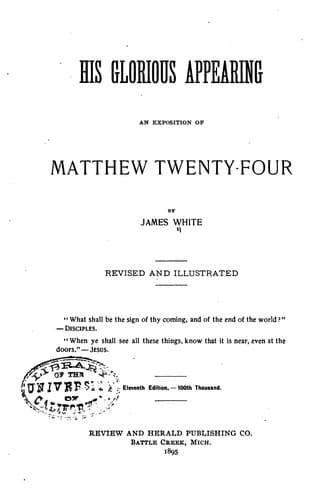
His Glorious Appearing: An Exposition of Matthew Twenty-FourWhite, James
Religion
His Glorious Appearing: An Exposition of Matthew Twenty-Four
White, James
Bible. Matthew, XXIV -- Commentaries; Second Advent
The dark place here spoken of is the future. The past is lighted up by
history, the present is brought to our knowledge by press and telegraph;
but the future no human art or wisdom can penetrate. Prophecy throws its
gleam into those dark regions, yet unexplored, and marks out the path of
human history centuries and ages before it has echoed to the footsteps of
mankind. When at last we pass along the pathway, we may, if we will,
recognize the waymarks set up here and there, every one of which is a
monument to the wisdom and knowledge of God, and the faithfulness of his
word. Those who have no eyes to discern these things, no ears to hear, nor
hearts to understand their significance, will pass on, and the final event
will come upon them unawares. Not so with those who take heed to the
things God has spoken.
We would not detract an iota from the force of the verse under
consideration. It means all it says. No man knows the definite time of
Christ’s coming. The day and hour, and even the year of the second advent
are purposely hidden. Some of the prophetic periods reach to the time of
the end, while others extend still farther down, very near to the end
itself; yet none of them reach to the coming of the Son of man. The
prophecies clearly point to the period of the second advent, but do not
give the definite time of that event.
But with this passage before us we may claim that it would be transcending
its meaning to claim upon its authority that nothing should or could be
known of the approach of Christ’s coming. More than that, it is not
inconsistent with the text nor improbable that prior to that event the
Lord will in his own way reveal that which has hitherto been withheld.
Those who claim that the text proves that nothing may be known of the
period of the second advent, make it prove too much for their own
unbelief. As recorded by Mark, the declaration reads: “But of that day and
that hour knoweth no man, no, not the angels which are in Heaven, neither
the Son, but the Father.” If the text proves that men will know nothing of
the period of the second advent, it also proves that angels will know
nothing of it, and also that the Son will know nothing of it, till the
event takes place! This position proves too much, therefore proves nothing
to the point. Christ will know of the period of his second advent to this
world. The holy angels who wait around the throne of heaven to receive
messages relative to the part they act in the salvation of men, will know
of the time of this closing event of salvation. And so will the waiting,
watching people of God understand. An old English version of the passage
reads, “But that day and hour no man maketh known, neither the angels
which are in heaven, neither the Son, but the Father.” This is the correct
reading, according to several of the ablest critics of the age. The word
_know_ is used in the same sense here that it is by Paul in 1 Cor. 2:2:
Public-domain text, read in full here on John Shaqi.
Reviews
Reviews
No reviews yet
Be the first to share your thoughts on this work.
Join the Discussion
Join the discussion
Sign in to leave a comment or review.
Sign InorCreate an account