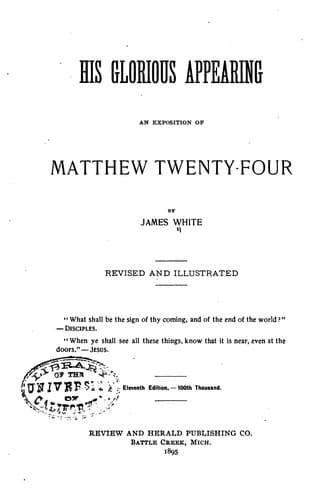
His Glorious Appearing: An Exposition of Matthew Twenty-FourWhite, James
Religion
His Glorious Appearing: An Exposition of Matthew Twenty-Four
White, James
Bible. Matthew, XXIV -- Commentaries; Second Advent
Jesus had been addressing the multitude, in the presence of his disciples.
He had reproved the scribes and the Pharisees for their sins, and had
declared, in the previous chapter, the doom of the Jews, their city, and
their temple. The disciples supposed that the temple would stand forever,
and they called the attention of Christ to its magnificence and strength,
and to the great stones that entered into the structure. On this point the
historian of those times, Josephus, says: “Now the temple was built of
stones that were white and strong, and each of their lengths was twenty‐
five cubits, their height was eight, and their breadth about
twelve.”—_“__Antiquities,__”__ book xv, chap. xi._ If we compute a cubit
at twenty inches, we shall be able to gain some idea of the size and
“manner” of these stones.
VERSE 2: “And Jesus said unto them, See ye not all these things?
Verily I say unto you, There shall not be left here one stone upon
another, that shall not be thrown down.”
VERSE 3: “And as he sat upon the mount of Olives, the disciples
came unto him privately, saying, Tell us, when shall these things
be? and what shall be the sign of thy coming, and of the end of
the world?”
This statement from the Master could not but deeply interest the
disciples. And it matters not whether they supposed that the destruction
of the temple, the coming of Christ, and the end of the age, would all
occur at the same time, or at different periods, since Christ, in his
answer in this chapter, has distinctly spoken of each separately, and has
given each its place in the prophetic history of events. If it were their
impression that the overthrow of the temple and the end of the world would
occur at the same time, it by no means proves that this would be the case.
As the Scriptures show, up to the time of the out‐pouring of the Holy
Spirit on the day of Pentecost, their ideas upon many points were crude
and inaccurate. Take as proof of this the parable which the Lord spake
when he was going into Jerusalem. Luke 19. They thought that the kingdom
of God should immediately appear. To correct this impression, the parable
of the nobleman was spoken. If they understood the parable at the time
when it was spoken, it did not fully eradicate the impression from their
minds, as is proved by what they did when they entered Jerusalem. We
cannot believe that they would have hailed him as the Son of David, and
rejoiced before him as a King in his triumph, if they had realized that he
was going into the city to be condemned and crucified as a malefactor.
Palm branches and shouts of triumph did not attend the steps of the lowly
and the condemned.
John admits for himself and Peter, after they had seen the empty
sepulcher, that “they knew not the scripture, that he must rise again from
the dead.” John 20:9.
Public-domain text, read in full here on John Shaqi.
Reviews
Reviews
No reviews yet
Be the first to share your thoughts on this work.
Join the Discussion
Join the discussion
Sign in to leave a comment or review.
Sign InorCreate an account