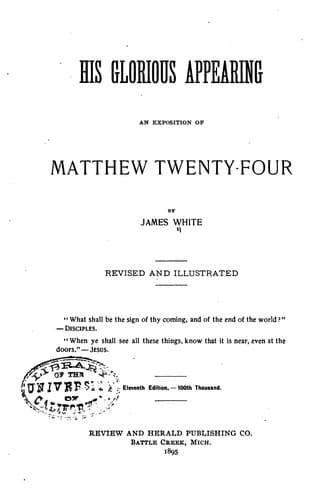
His Glorious Appearing: An Exposition of Matthew Twenty-FourWhite, James
Religion
His Glorious Appearing: An Exposition of Matthew Twenty-Four
White, James
Bible. Matthew, XXIV -- Commentaries; Second Advent
In the former part of the second century Cazibee set himself at the head
of the Jewish nation and proclaimed himself their long‐expected Messiah.
To facilitate the success of his bold enterprise he changed his name to
that of Barchocheba, alluding to the Star foretold by Balaam. Adrian
raised an army, and sent it against him. He retired into a town called
Bither, where he was besieged. Barchocheba was killed in the siege, the
city was taken, and a dreadful havoc succeeded. The Jews themselves allow
that, during this short war against the Romans in defense of this false
Messiah, they lost five or six hundred thousand souls.—_Buck’s
Dictionary._
Dr. A. Clarke says, on the authority of Josephus, that “a few years
afterward, under the reign of Nero, while Felix was procurator of Judea,
impostors of this stamp were so frequent that some were taken and killed
almost every day.” And at intervals since then the Jews who are all the
time expecting the appearance of the Messiah have been repeatedly the
victims of cruel deception.
VERSE 6: “And ye shall hear of wars and rumors of wars. See that
ye be not troubled: for all these things must come to pass, but
the end is not yet.”
It is proper that we should consider what is meant by the term “the end,”
used in this verse; in verse 14, “then shall the end come;” and in verse
3, “the sign of thy coming, and the end of the world.” In the first place,
it may be unhesitatingly claimed that the term does not refer to the end
of the Jewish dispensation, which terminated at the crucifixion, nor to
the destruction of Jerusalem, which occurred about forty years later.
Because, first, Jesus treated the question concerning the destruction of
the temple and that referring to his coming and the end of the world as
relating to two distinct events, widely separated in time. Second, the
signs which were to be premonitory of the end did not transpire before the
destruction of the temple. Third, the second coming of Christ, the close
of probation, the judgment, the resurrection, and the end of sin, death,
and mortality, are frequently and prominently associated together in the
Bible as constituting the most important epoch in human history. To limit
this thrilling discourse to the local and long past destruction of
Jerusalem would be to rob it of its force and grandeur. Not only would the
twenty‐fourth of Matthew which we are now studying be stultified, but very
much of the life and power of the Scriptures would be sacrificed by such a
course.
As to the meaning of the phrase, “the end of the world,” it may
consistently be translated “the end of the age,” and in the margin of the
Revised Bible it is rendered “the consummation of the age.” For an
inspired definition of the term, let the reader turn to Matt. 13:38‐40 and
its context, where the same words are used and repeated in the original:—
Public-domain text, read in full here on John Shaqi.
Reviews
Reviews
No reviews yet
Be the first to share your thoughts on this work.
Join the Discussion
Join the discussion
Sign in to leave a comment or review.
Sign InorCreate an account