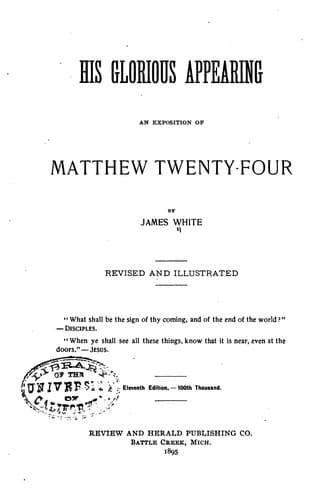
His Glorious Appearing: An Exposition of Matthew Twenty-FourWhite, James
Religion
His Glorious Appearing: An Exposition of Matthew Twenty-Four
White, James
Bible. Matthew, XXIV -- Commentaries; Second Advent
The sacred writers have so uniformly associated such judgments as war,
famine, pestilence, and earthquake, with the last Judgment, that the
disciples would be in danger of concluding that the end would immediately
follow the first appearance of these calamities; hence the caution given:
“These things must come to pass, but the end is not yet.” Here the
disciples were clearly taught that they should not expect the end in their
day. This fact is worthy of the candid attention of those who object to
the proclamation of the second advent of Christ in the form of an especial
message. These sometimes assert that it was right for the disciples to
look for Christ in their day, and that it has been scriptural and right
for all Christians to look for the second appearing of Christ in their
time, from the days of the chosen twelve to the present time. And they
decide that no more can be learned and believed upon this subject in our
time than by the Christians of past generations, and that the public mind
should not now be moved upon this great question, any more than in all
past time since the first advent of Christ.
We have seen that this position is incorrect so far as the early disciples
were concerned. They are directed to the distant future as the time when
their Lord should come. They are assured that they need not be troubled at
hearing of wars and rumors of wars; “for all these things must come to
pass, but the end is not yet.” Our Lord then guides the minds of his
disciples, as we shall see in the examination of this chapter, down over
the time of the great apostasy, and the long period of the rule of papal
Rome, before mentioning a sign of his second advent. He does not intimate
that his people during these long periods may expect the end. No, not
once. But when he comes to a later time, the Lord names signs in the sun,
in the moon, and in the stars, and adds: “When ye shall see all these
things, know that it is near, even at the doors.”
Mark this: Our Lord does not mention wars, famines, pestilences, and
earthquakes as signs of his second advent; but rather as events of common
occurrence all the way through the Christian age, which must exist before
the end. And history attests the fact that these calamities have covered
at least seventeen centuries. The following is from a work of Noah
Webster, LL. D., published in 1799:—
“By famine and sword, 580,000 Jews were destroyed between A. D. 96
and A. D. 180.
“In Antioch, from A. D. 96 to A. D. 180, earthquakes destroyed 13
cities and over 100,000 lives.
“In Rome, A. D. 169, pestilence destroyed 10,000 daily.
“In Rome, A. D. 187, pestilence appeared and continued three
years.
“In London, A. D. 310, by famine, 40,000 died.
“In A. D. 446, September 17, an earthquake shook down the walls of
Constantinople, and 57 towers fell.
“In Rome, A. D. 539, in one district 50,000 died.
“In Antioch, A. D. 588, an earthquake killed 60,000.
Public-domain text, read in full here on John Shaqi.
Reviews
Reviews
No reviews yet
Be the first to share your thoughts on this work.
Join the Discussion
Join the discussion
Sign in to leave a comment or review.
Sign InorCreate an account