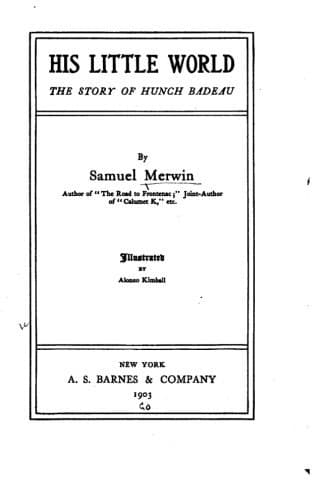
His Little World: The Story of Hunch BadeauMerwin, Samuel
General
His Little World: The Story of Hunch Badeau
Merwin, Samuel
Great Lakes (North America) -- Fiction; Love stories; Schooners -- Fiction; Ship captains -- Fiction
When they reached the street two of the other men turned and shook hands
with him; but he had nothing to say, and a moment later he was walking
alone, slowly, up the bridge approach. The examination was over and he
was free. His case had not reached a trial, for he had killed Considine
plainly in self-defense.
A long row of schooners, steamers, and tugs lay along the docks on both
sides of the river. On most of the schooners a length of stovepipe came
out of a cabin window, and a few wisps of smoke, winding lazily out
to be snatched away by the wind, showed that many a sailor was lying
dormant during the winter months. Hunch lingered on the bridge. He had
once spent such a winter in Chicago on a big schooner, locked up snugly
in the North Branch near Goose Island, eating and sleeping, smoking and
swapping yams, and helping to drink up somebody's summer profits. That
was a long while ago; it seemed to Hunch a dim part of some past life,
before he had ever met a woman other than the rough girls of the Chicago
levee and the North Peninsula stockades.
Mr. Jackson had told Hunch that he need not go back to work that day,
so he climbed to his room and sat on the chair by the window. Bruce's
things were lying about the room; his razor on the bureau, his Sunday
clothes over a chair in the closet, his shoes under the foot of the bed.
Hunch got up and began to get them together, without knowing exactly why
he was doing it. He packed what he could in the patent-leather valise,
and made up the rest into bundles, borrowing paper and string from the
landlady. Then he sat down again, but before long, too restless to stay
alone, he put on his coat and walked out to the mill. Mr. Jackson was
standing near the waste dump with a memorandum book in his hand.
“Well, Badeau, what's the matter?”
“Nothing. Guess I might's well get to work.”
“Just as you like.”
The men looked surprised when he joined them. He was nervous and he
worked both himself and them at a pace that wore them out in a few
hours. But at six o'clock, when the whistle blew, and he put on his coat
and went back to the boarding-house, he felt refreshed.
On Sunday, after several days of hesitating over the best way to get
Bruce's things to Mamie, Hunch gathered up the bundles and the valise,
and took the noon train to Liddington. He sat for two hours in the
station before he could make up his mind to take them to Joe Cartier's
house. When he finally knocked at the door, Joe's wife opened it.
“How d'ye do, Mr. Badeau? Come in, won't you?”
“No, I can't,” said Hunch. “Hold on; yes, I will, too, just a minute.
Where's Joe?”
“Here he is,” replied Joe himself, coming through the hall in his
shirt-sleeves. “Come in, and set down.”
Hunch stepped in and dropped the bundles in the corner.
“Can I speak to you a minute, Joe?”
Public-domain text, read in full here on John Shaqi.
Reviews
Reviews
No reviews yet
Be the first to share your thoughts on this work.
Join the Discussion
Join the discussion
Sign in to leave a comment or review.
Sign InorCreate an account