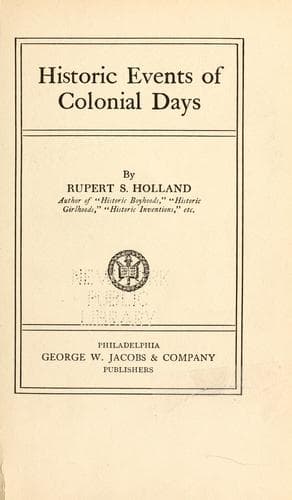
Historic Events of Colonial DaysHolland, Rupert Sargent
History
Historic Events of Colonial Days
Holland, Rupert Sargent
United States -- History -- Colonial period, ca. 1600-1775
The Dutch Government in Europe called Peter Stuyvesant there to explain
why he had surrendered his colony. He went to Holland and made his acts
so clear to the States-General that they held him guiltless of every
charge against him. Then he returned to New York and settled down at his
bouwery, where he lived comfortably and well, like most of his Dutch
neighbors, unvexed by the constant troubles he had known when he was the
governor.
The colony of New York grew and prospered. The patroons lived on their
big estates, rich, hospitable families, much like the wealthy planters
of Virginia. The Dutch people in the towns were a thrifty, peaceable
lot, glad to welcome new settlers, no matter from where they came. Most
of the settlers came now from England, very few from the Netherlands;
and in time there were more English than Dutch in the province. By the
time of the Revolution the people of the two nations were practically
one in their ideas and aims. Dutch and English fought side by side in
that war, and helped to make the great state of New York. But the Dutch
blood and the Dutch virtues persisted, and many of the greatest men of
the new state bore old Dutch names. And so, though Peter Stuyvesant and
his neighbors had to haul down their flag from their primitive ramparts
at Fort Amsterdam, they and their descendants left their stamp upon that
part of the New World they had been the first to settle.
III
WHEN GOVERNOR ANDROSS CAME TO CONNECTICUT
(_Connecticut, 1675_)
One of the most interesting stories in the history of the American
colonies is that of the adventures of the judges who voted for the
execution of King Charles I of England and who fled across the water
when his son came to the throne as Charles II. They were known as the
regicides, a name given to them because they were held to be responsible
for the king's death. When Charles II came back to England as king,
after the days when Oliver Cromwell was the Lord Protector, he pardoned
many of the men who had taken sides against his father, but his friends
urged him not to be so generous in his treatment of the judges. So he
issued a proclamation, stating that such of the judges of King Charles I
as did not surrender themselves as prisoners within fourteen days should
receive no pardon. The regicides and their friends were greatly alarmed.
Nineteen surrendered to the king's officers; some fled across the ocean;
and others were arrested as they tried to escape. Ten of them were
executed. Two, Edward Whalley and William Goffe, reached Boston Harbor
in July, 1660. Another, John Dixwell, came afterward.
Governor Endicott and the leading men of Boston, not knowing how King
Charles intended to treat the judges, welcomed them as men who had held
posts of honor in England. They were entertained most hospitably in the
little town, and they went about quite freely, making no attempt to
conceal from any one who they were.
Public-domain text, read in full here on John Shaqi.
Reviews
Reviews
No reviews yet
Be the first to share your thoughts on this work.
Join the Discussion
Join the discussion
Sign in to leave a comment or review.
Sign InorCreate an account