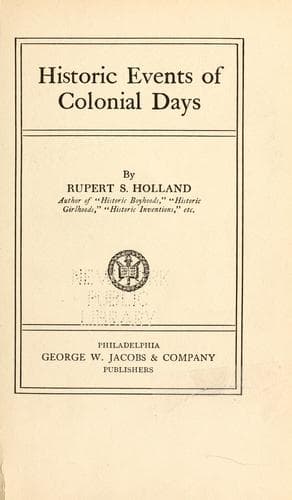
Historic Events of Colonial DaysHolland, Rupert Sargent
History
Historic Events of Colonial Days
Holland, Rupert Sargent
United States -- History -- Colonial period, ca. 1600-1775
On June 5, 1676, Bacon went to the State House. The governor and his
council sat with the burgesses, and Sir William Berkeley spoke to them
about recent border fights between Virginians and Indians. He denounced
the killing of six Indian chiefs in Maryland, who, he said, had come to
treat of peace with white soldiers, and he added, "If they had killed my
grandfather and grandmother, my father and mother and all my friends,
yet if they had come to treat of peace, they ought to have gone in
peace."
Sir William sat down; then after a few minutes stood up again. "If there
be joy in the presence of the angels over one sinner that repenteth,"
said he, with solemn humor, "there is joy now, for we have a penitent
sinner come before us. Call Mr. Bacon."
Bacon came in, and knelt down before the governor and his council and
his fellow Virginians. He read from a paper he held, confessing that he
had been guilty of "unlawful, mutinous, and rebellious practices," and
promised that if the governor would pardon him he would act "dutifully,
faithfully, and peaceably," under a penalty of two thousand pounds
sterling. He pledged his whole estate for his good behavior for one
year.
When Bacon had finished, Sir William said, "God forgive you; I forgive
you." And to make the words more impressive he repeated them three
times.
"And all that were with him," said Colonel Cole, a member of the
council, meaning the men who had rebelled with Bacon and fought the
Indians.
"Yes, and all that were with him," the governor agreed. Then Sir William
added, "Mr. Bacon, if you will live civilly but till next
quarter-day,--but till next quarter-day," he repeated the words, "I'll
promise to restore you to your place there!" and he pointed to the seat
which Bacon had sometimes occupied during meetings of the council.
All was peace again; the black sheep had repented and been allowed to
return to the fold. It was generally understood that in return for
Bacon's apology the governor would now give him the commission he had
asked for before, the commission as "General of the Indian Wars," which
would allow him to protect outlying plantations against Indian raids.
Sir William pardoned the rebel on Saturday, and "General Bacon," as many
people in Jamestown already spoke of him, took up his lodgings at the
house of a Mr. Lawrence, there to wait until his expected commission
should be sent him early the next week. Mr. Porter and his son, and many
of the friends who had come in Bacon's sloop, took rooms at near-by
houses, for their leader might be going back to Curles as soon as he had
his commission, and they wanted to go with him.
Public-domain text, read in full here on John Shaqi.
Reviews
Reviews
No reviews yet
Be the first to share your thoughts on this work.
Join the Discussion
Join the discussion
Sign in to leave a comment or review.
Sign InorCreate an account