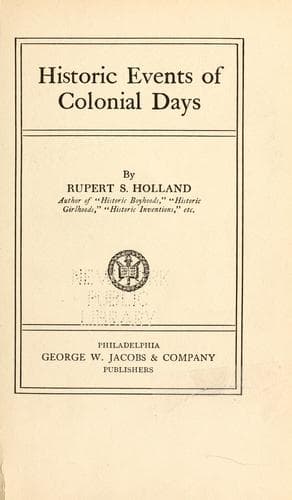
Historic Events of Colonial DaysHolland, Rupert Sargent
History
Historic Events of Colonial Days
Holland, Rupert Sargent
United States -- History -- Colonial period, ca. 1600-1775
Meantime General Bacon crossed the James River, attacked the Appomattox
Indians, and killed or routed the whole tribe. He then marched along the
south side of the river toward the Nottoway and Roanoke, scattered all
the Indians he met, and ultimately returned north to West Point, where
he dismissed all his army but a small detachment, bidding the others go
back to their own plantations to harvest the autumn crops.
Scarcely had the men of Bacon's army reached their homes when a new
message electrified the whole countryside. From man to man the news ran
that Sir William Berkeley, with seventeen ships and a thousand men, had
come back from far-away Accomac, had sailed up the James River, had
taken possession of Jamestown, and was now flying his flag above the
State House there.
III
Sir William Berkeley had met few friends in that distant country of
Accomac when he had first flown there. Rebellion was in the air there as
it was on the mainland of Virginia, and only a few of the planters of
the eastern shore welcomed the king's governor and agreed to stand by
him in his fight with Nathaniel Bacon. Still he stuck to his
determination to try conclusions with the rebels, and meantime he waited
as patiently as he could, hoping that the tide of fortune would
presently turn in his favor.
General Bacon, when he set out from Middle-Plantation to fight the
Indians, sent Giles Bland to keep Governor Berkeley in Accomac, and, if
possible, to induce the people there to surrender him. Giles Bland
started on his mission with two hundred and fifty men, and one ship with
four guns, commanded by an old sailor, Captain Carver. One ship was not
enough, however, to carry the men across to the Eastern Shore, and so
Bland seized another that happened to be lying in the York River, and
that belonged to Captain Laramore, a friend of Governor Berkeley.
Captain Laramore was seized by Bland's men, and locked up in his cabin,
but after a time he sent word to Bland that he would fight with him
against the governor, and Bland, thinking that the captain was sincere,
restored command of the vessel to him. Two more ships were captured, and
so it was a fleet of four vessels that ultimately carried the rebel
party to the Eastern Shore.
Public-domain text, read in full here on John Shaqi.
Reviews
Reviews
No reviews yet
Be the first to share your thoughts on this work.
Join the Discussion
Join the discussion
Sign in to leave a comment or review.
Sign InorCreate an account