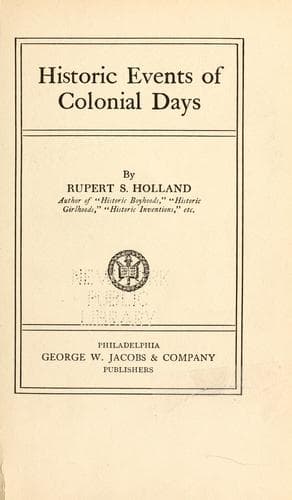
Historic Events of Colonial DaysHolland, Rupert Sargent
History
Historic Events of Colonial Days
Holland, Rupert Sargent
United States -- History -- Colonial period, ca. 1600-1775
The island of Manhattan, which is now tightly packed with the
office-buildings and houses of New York, was in 1661 the home of a small
number of families who had come across the Atlantic Ocean from the
Netherlands to settle this part of the new world for the Dutch West
India Company. There was a fort at the southern end of the island,
sometimes known as the Battery, and two roads led from it toward the
north. One of these roads followed the line of the street now called
Broadway, running north to a great open field, or common, and, skirting
that, leading on to the settlement of Harlaem. In time this road came to
be known as the Old Post Road to Boston. Another road ran to the east,
and in its neighborhood were the farms of many of the richer Dutch
settlers. Near where Third Avenue and Thirteenth Street now meet was the
bouwery, as the Dutchmen called a farm, of Peter Stuyvesant, the
governor of the colony of New Netherland. It was a large, prosperous
bouwery, with a good-sized house for the governor and his family.
This Dutch governor, sturdy, impetuous, obstinate, had lost a leg while
leading an attack on the Portuguese island of Saint Martin, in 1644, and
now used a wooden stump, which caused him to be nicknamed "Wooden-Legged
Peter." He was a much better governor than the others who had been sent
out by the West India Company to rule New Netherland. He had plenty of
courage, but he had also a very determined will of his own, which often
made him seem a tyrant to the other settlers.
Now there were two distinct classes of people in New Netherland: the
peasants who worked the land, and the landowners, called patroons, who
had bought vast tracts from the West India Company, and lived on them
like European nobles. It was the patroons who brought the peasants over,
paying for their passage, and the peasants worked for them until they
could repay the amount of their passage money, and then took up small
farms on their patroon's estate, paying the rental in crops, as tenants
did to the feudal lords of Europe. The great manors stretched north from
the little town of New Amsterdam at the point of Manhattan Island. Above
Peter Stuyvesant's bouwery was the manor of the Kip family, called Kip's
Bay. In the middle of the island lived the Patroon De Lancey. Opposite,
on Long Island, was the estate of the Laurences. And along the Hudson
were the homes of the powerful families of Van Courtland and of
Phillipse, of Van Rensselaer and of Schuyler. In spite of constant
danger from Indians and their great distance from Europe the patroons
lived in a certain magnificence, and grew in power down to the time of
the Revolution. Farming and fur-trading were the chief sources of profit
of the colony. There were a few storekeepers and mechanics, but they
lived close to the fort and stockade at the Battery. The trades that had
done so much to make the Netherlands in Europe rich played small part in
the life of this New Netherland.
Public-domain text, read in full here on John Shaqi.
Reviews
Reviews
No reviews yet
Be the first to share your thoughts on this work.
Join the Discussion
Join the discussion
Sign in to leave a comment or review.
Sign InorCreate an account