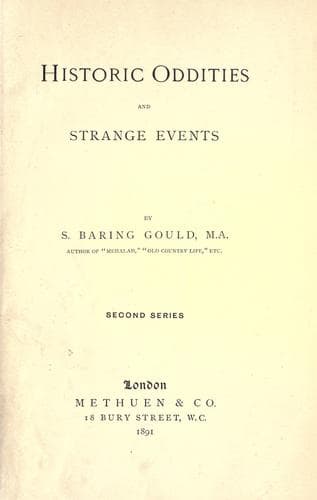
Historic Oddities and Strange EventsBaring-Gould, S. (Sabine)
History
Historic Oddities and Strange Events
Baring-Gould, S. (Sabine)
History; Mysticism; Patarines
Among those who entered was a smith called Wetzell; he dashed forward,
flung a pail of water over the burning table, caught hold of the feet of
the dead body, and dragged it into the ante-room. Then he sought to
raise it, but it slipped through his hands. A second came to his
assistance, with the same result. The corpse was like melted butter.
When he seized it by the arm, the flesh came away from the bone.
The body was laid on a mat, and so transported into a cabinet. The upper
portion was burnt to coal; one hand was charred; on the left foot was a
shoe, the other was found, later, in another room. More water was
brought, and the fire in the parlour was completely quenched. Then only
was it possible to examine the place. The fire had, apparently,
originated at the writing-desk or secretaire of the Countess; the body
had lain before the table, and near it was a chair, thrown over. From
the drawing-room a door, which was found open, led into the boudoir.
This boudoir had a window that looked into a side street. In the
ante-room were no traces of fire. In the drawing-room only the
secretaire and the floor beneath it had been burnt. On a chiffonier
against the wall were candlesticks, the stearine candles in them had
been melted by the heat of the room and run over the chiffonier.
In this room was also a sofa, opposite the door leading from the
ante-chamber, some way from the desk and the seat of the fire. In the
middle of the sofa was a hole fourteen inches long by six inches broad,
burnt through the cretonne cover, the canvas below, and into the horse
hair beneath. A looking-glass hung against the wall above; this glass
was broken and covered with a deposit as of smoke. It was apparent,
therefore, that a flame had leaped up on the sofa sufficiently high and
hot to snap the mirror and obscure it.
Left of the entrance-door was a bell-rope, torn down and cast on the
ground.
Beyond the parlour was the boudoir. It had a little corner divan. Its
cover was burnt through in two places. The cushion at the back was also
marked with holes burnt through. Above this seat against the wall hung
an oil painting. It was blistered with heat. Near it was an étagère, on
which were candles; these also were found melted completely away. In
this boudoir was found the slipper from the right foot of the Countess.
If the reader will consider what we have described, he will see that
something very mysterious must have occurred. There were traces of
burning in three distinct places--on the sofa, and at the secretaire in
the parlour, and on the corner seat in the boudoir. It was clear also
that the Countess had been in both rooms, for her one slipper was in the
boudoir, the other on her foot in the drawing-room. Apparently, also,
she had rung for assistance, and torn down the bell-rope.
Public-domain text, read in full here on John Shaqi.
Reviews
Reviews
No reviews yet
Be the first to share your thoughts on this work.
Elsewhere in the archive
Join the Discussion
Join the discussion
Sign in to leave a comment or review.
Sign InorCreate an account