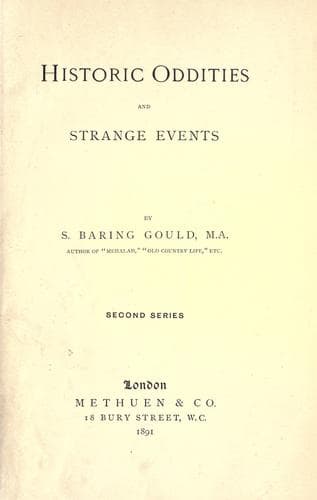
Historic Oddities and Strange EventsBaring-Gould, S. (Sabine)
History
Historic Oddities and Strange Events
Baring-Gould, S. (Sabine)
History; Mysticism; Patarines
Another very significant and mysterious feature of the case was the fact
that the two doors were found locked, and that the key was not found
with the body, nor anywhere in the rooms. Consequently, the Countess had
not locked herself in.
Again:--the appearance of the corpse was peculiar. The head and face
were burnt to cinder, especially the face, less so the back of the head.
All the upper part of the body had been subjected to fire, as far as the
lower ribs, and there the traces of burning ceased absolutely. Also, the
floor was burnt in proximity to the corpse, but not where it lay. The
body had protected the floor where it lay from fire.
The police were at once informed of what had taken place, and the
magistrates examined the scene and the witnesses. This was done in a
reprehensibly inefficient manner. The first opinion entertained was that
the Countess had been writing at her desk, and had set fire to herself,
had run from room to room, tried to obtain assistance by ringing the
bell, had failed, fallen, and died. Three medical men were called in to
examine the body. One decided that this was a case of spontaneous
combustion. The second that it was not a case of spontaneous combustion.
The third simply stated that she had been burnt, but how the fire
originated he was unable to say. No minute examination of the corpse was
made. It was not even stripped of the half-burnt clothes upon it. It was
not dissected. The family physician signed a certificate of "accidental
death," and two days after the body was buried.
Only three or, at the outside, four hypotheses could account for the
death of the Countess.
1. She had caught fire accidentally, whilst writing at her desk.
2. She had died of spontaneous combustion.
3. She had been murdered.
There is, indeed, a fourth hypothesis--that she had committed suicide;
but this was too improbable to be entertained. The manner of death was
not one to be reconciled with the idea of suicide.
The first idea was that in the minds of the magistrates. They were
prepossessed with it. They saw nothing that could militate against it.
Moreover, the Count was Chamberlain at Court, a favourite of the
sovereign and much liked by the princes, also a man generally respected.
Unquestionably this had something to do with the hasty and superficial
manner in which the examination was gone through. The magistrates
desired to have the tragedy hushed up.
Public-domain text, read in full here on John Shaqi.
Reviews
Reviews
No reviews yet
Be the first to share your thoughts on this work.
Elsewhere in the archive
Join the Discussion
Join the discussion
Sign in to leave a comment or review.
Sign InorCreate an account