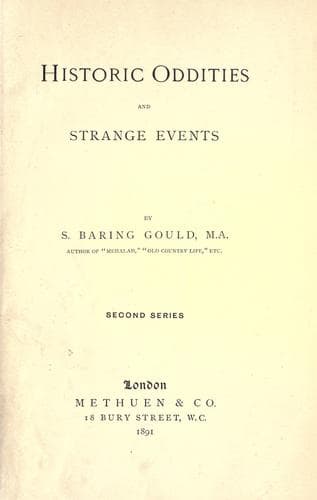
Historic Oddities and Strange EventsBaring-Gould, S. (Sabine)
History
Historic Oddities and Strange Events
Baring-Gould, S. (Sabine)
History; Mysticism; Patarines
The Countess was mean and miserly, she grudged allowing her husband any
of her money. She had, however, made her will the year before, leaving
all her large fortune to her husband for life. Consequently her death
released him from domestic and pecuniary annoyances. On the morning
after the death he sent for the agent of the insurance company with
whom the furniture and other effects were insured and made his claim. He
claimed, in addition to the value of the furniture destroyed, the worth
of a necklace of diamonds and pearls which had been so injured by the
fire that it had lost the greater part of its value. The pearls were
quite spoiled, and the diamonds reduced in worth by a half. The agent
refused this claim, as he contended that the jewelry was not included in
the insurance, and the Count abstained from pressing it.
To the Count the situation became at length intolerable. He perceived a
decline of cordiality in his reception at Court, his friends grew cold,
and acquaintances cut him. He must clear himself of the charge which now
weighed on him. The death of the Countess had occurred on June 13, 1847.
On October 6, that is four months later, Count Goerlitz appeared before
the Grand-Ducal Criminal Court of Darmstadt, and produced a bundle of
German newspapers charging him with having murdered his wife, and set
fire to the room to conceal the evidence of his crime. He therefore
asked to have the case re-opened, and the witnesses re-examined. Nothing
followed. The Court hesitated to take up the case again, and throw
discredit on the magistrates' decision in June. Again, on October 16,
the Count renewed his request, and desired, if this were refused, that
he and his solicitor might be allowed access to the minutes of the
examination, that they might be enabled to take decided measures for the
clearing of the Count's character, and the chastisement of those who
charged him with an atrocious crime. On October 21, he received a
reply, "that his request could not be granted, unless he produced such
additional evidence as would show the Court that the former examination
was defective."
On October 25, the Count laid a mass of evidence before the Court which,
he contended, would materially modify, if not absolutely upset the
conclusion arrived at by the previous investigation.
Then, at last, consent was given; but proceedings did not begin till
November, and dragged on till the end of October in the following year,
when a new law of criminal trial having been passed in the grand-duchy,
the whole of what had gone before became invalid, save as preliminary
investigation, and it was not till March 4, 1850--that is, not till
_three years_ after the death of the Countess--that the case was
thoroughly sifted and settled. Before the promulgation of the law of
October, 1848, all trials were private, then trial by jury, and in
public, was introduced.
Public-domain text, read in full here on John Shaqi.
Reviews
Reviews
No reviews yet
Be the first to share your thoughts on this work.
Elsewhere in the archive
Join the Discussion
Join the discussion
Sign in to leave a comment or review.
Sign InorCreate an account