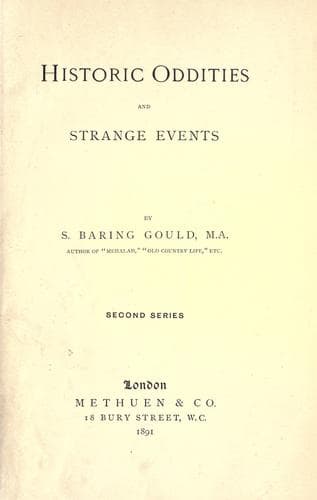
Historic Oddities and Strange EventsBaring-Gould, S. (Sabine)
History
Historic Oddities and Strange Events
Baring-Gould, S. (Sabine)
History; Mysticism; Patarines
The Elector Frederick Christian of Saxony reigned only a few weeks, from
October 5th to December 13, 1763; in his forty-first year he died of
small-pox. He never had enjoyed rude health. The mother of the
unfortunate prince, Marie Josepha of Austria, was an exceedingly ugly,
but prolific lady, vastly proud of her Hapsburg descent. The three first
children followed each other with considerable punctuality, but the two
first, both sons, died early. Frederick Christian was the third. The
Electress, a few months before his birth, was hunting, when a deer that
had been struck, turned to her, dragging its broken legs behind it. This
produced a powerful impression on her mind; and when her son was born,
he was found to be a cripple in his legs. His head and arms were well
formed, but his spine was twisted, and his knees, according to the
English ambassador, Sir Charles Williams--were drawn up over his
stomach. He could not stand, and had to be lifted about from place to
place. At the age of five-and-twenty he had been married to Maria
Antonia, daughter of the Elector of Bavaria, afterwards the Emperor
Charles VII.
His brother, Francis Xavier, was a sturdy fellow, like his father, and
the Electress mother tried very hard to get Frederick Christian to
resign his pretentions in favour of his brother, and take holy orders.
This he refused to do, and was then married to Maria Antonia, aged
twenty-three. Her mother had also been an Austrian princess, Amalia, and
also remarkable for her ugliness. The choice was not happy, it brought
about a marriage between cousins, and an union of blood that was
afflicted with ugliness and infirmity of body.
Maria Antonia had not only inherited her mother's ugliness, but was
further disfigured with small-pox. She was small of stature, but of a
resolute will, and of unbounded ambition. English tourists liked her,
they said that she laid herself out to make the Court of Dresden
agreeable to them. Wraxall tells a good story of her, which shows a
certain frankness, not to say coarseness in her conversation--a story we
will not reproduce.
She had already made her personality felt at the Bavarian Court. Shortly
after the death of her father, in imitation of Louisa Dorothea, Duchess
of Gotha, she had founded an "Order of Friendship, or the Society of the
Incas." The founding of the Order took place one fine spring day on a
gondola in the canal at Nymphenburg. Her brother, the Elector of
Bavaria, was instituted a member, the Prince of Fürstenberg was made
chancellor, and was given the custody of the seal of the confraternity
which had as its legend "La fidelité mêne." The badge of the Order was a
gold ring on the little finger of the left hand, with the inscription,
"L'ordre de l'amitié--Maria Antonia." Each member went by a name
descriptive of his character, or of that virtue he or she was supposed
to represent. Thus the chancellor was called "Le Solide."
Public-domain text, read in full here on John Shaqi.
Reviews
Reviews
No reviews yet
Be the first to share your thoughts on this work.
Elsewhere in the archive
Join the Discussion
Join the discussion
Sign in to leave a comment or review.
Sign InorCreate an account