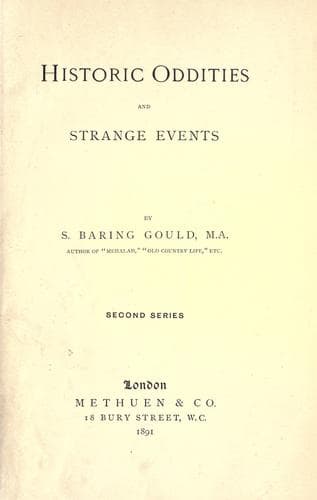
Historic Oddities and Strange EventsBaring-Gould, S. (Sabine)
History
Historic Oddities and Strange Events
Baring-Gould, S. (Sabine)
History; Mysticism; Patarines
Sir Charles Williams says that on the very first night of her appearance
in Dresden she made an attempt to force herself into a position for
which she had no right; to the great annoyance of the King of Poland
(Augustus, Elector of Saxony).
At Dresden, she favoured the arts, especially music and painting. She
became the patroness of the family Mengs. She sang, and played on the
piano, and indeed composed a couple of operas, "Thalestris" and "Il
trionfo della fidelita," and the former was actually put on the stage.
Sir Charles Williams in 1747 wrote that, in spite of her profession that
in her eyes no woman ought to meddle in the affairs of state, he
ventured to prophecy, she would rule the whole land in the name of her
unfortunate husband.
Nor was he wrong. The moment that her father-in-law died, she put her
hand on the reins. She was not likely to meet with resistance from her
husband, he was not merely a cripple in body, but was contracted in his
intellect; he was amiable, but weak and ignorant. Sir Charles Williams
says that he once asked at table whether it was not possible to reach
England by land--_although_ it was an island.
Frederick Christian began to reign on 5th October 1763, and immediately
orders were given for the increase of the army to 50,000 men. Maria
Antonia was bent on becoming a queen, and for this end she must get her
husband proclaimed like his father, King of Poland. She was allied to
all the Courts of Europe, her agreeable manners, her energy, gained her
friends in all quarters. She felt herself quite capable of wearing a
royal crown, and she wrote to all the courts to urge the claims of her
husband, the Elector, when--the unfortunate cripple was attacked by
small-pox, had a stroke, and died December 17th. Small-pox had carried
off his ancestor John George IV., and in that same century it occasioned
the death of his brother-in-law, Max Joseph of Bavaria, and of the
Emperor Joseph I.
He left behind him four sons, his successor, Frederick Augustus, and the
three other princes, Charles, his mother's favourite, Anthony, and
Maximilian Joseph, the third of whom died the same year as his father.
He had also two daughters.
The death of her husband was a severe blow to the ambition of the
Electress; her eldest son, Frederick Augustus, was under age, and the
reins of government were snatched from her hands and put into those of
the uncle of the young Elector, Xavier, who had been his mother's
favourite, and in favour of whom his elder brother had been urged to
resign his pretensions. Xavier was appointed administrator of Saxony,
and acted as such for five years.
When, at the age of eighteen, Frederick Augustus III. assumed the power,
he endeavoured to fulfil his duties with great diligence and
conscientiousness, and allowed of no interference. He had, indeed, his
advisers, but these were men whom he selected for himself from among
those who had been well tried and who had proved themselves trusty.
Public-domain text, read in full here on John Shaqi.
Reviews
Reviews
No reviews yet
Be the first to share your thoughts on this work.
Elsewhere in the archive
Join the Discussion
Join the discussion
Sign in to leave a comment or review.
Sign InorCreate an account