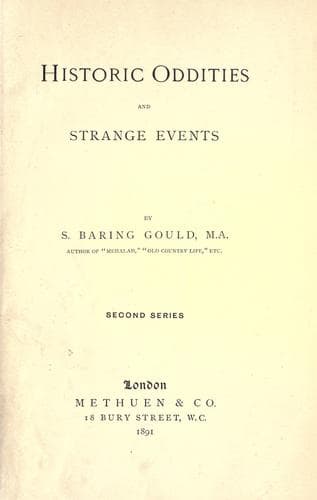
Historic Oddities and Strange EventsBaring-Gould, S. (Sabine)
History
Historic Oddities and Strange Events
Baring-Gould, S. (Sabine)
History; Mysticism; Patarines
Hallwachs and the other rascals who had been confederated with him in
plundering their country were banished, but were allowed to depart with
all their plunder.
Remchingen also escaped; when arrested, he managed to get rid of all
compromising papers, which were given by him to a chimney-sweep sent to
him down the chimney by some of the agents of the Bishop of Würzburg.
Such is the tragic story of the life of Suess Oppenheim, a man of no
ordinary abilities, remarkable shrewdness, but without a spark of
principle. But the chief tragedy is to be found in the deterioration of
the character of Duke Charles Alexander, who, as Austrian field-marshal
and governor of Servia, had been the soul of honour, generous and
beloved; who entered on his duchy not only promising good government,
but heartily desiring to rule well for his people's good; and who in
less than four years had forfeited the love and respect of his subjects,
and died meditating an act which would have branded him as
perjured--died without having executed one of his good purposes, and so
hated by the people who had cheered him on his entry into the capital,
that, by general consent, the mode of his death was not too curiously
and closely inquired into.
FOOTNOTES:
[18] There was some idea of a younger brother being elected.
[19] In three years Suess gained a profit of 20,000 florins out of the
sale of jewellery alone.
[20] The Duke, at Suess's instigation, wrote to the Emperor to get the
Jew factotum ennobled, but was refused.
[21] On the following night a confectioner set up a transparency
exhibiting the Devil carrying off the Duke.
Ignatius Fessler.
On December 15th, 1839, in his eighty-fourth year, died Ignatius
Fessler, Lutheran Bishop, at St. Petersburg, a man who had gone through
several phases of religious belief and unbelief, a Hungarian by birth, a
Roman Catholic by education, a Capuchin friar, then a deist, almost, if
not quite, an atheist, professor of Oriental languages in the university
of Lemberg, finally Lutheran Bishop in Finland.
He was principally remarkable as having been largely instrumental in
producing one of the most salutary reforms of the Emperor Joseph II.
His autobiography published by him in 1824, when he was seventy years
old, affords a curious picture of the way in which Joseph carried out
those reforms, and enables us to see how it was that they roused so much
opposition, and in so many cases failed to effect the good that was
designed.
Fessler, in his autobiography, paints himself in as bright colours as he
can lay on, but it is impossible not to see that he was a man of little
principle, selfish and heartless.
The autobiography is so curious, and the experiences of Fessler so
varied, the times in which he lived so eventful, and the book itself so
little known, that a short account of his career may perhaps interest,
and must be new to the generality of readers.
Public-domain text, read in full here on John Shaqi.
Reviews
Reviews
No reviews yet
Be the first to share your thoughts on this work.
Elsewhere in the archive
Join the Discussion
Join the discussion
Sign in to leave a comment or review.
Sign InorCreate an account