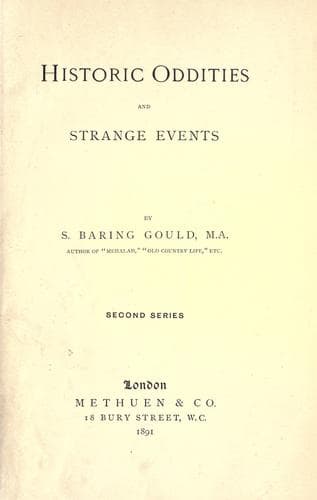
Historic Oddities and Strange EventsBaring-Gould, S. (Sabine)
History
Historic Oddities and Strange Events
Baring-Gould, S. (Sabine)
History; Mysticism; Patarines
Ignatius Fessler was the son of parents in a humble walk of life
resident in Hungary, but Germans by extraction. Ignatius was born in the
year 1754, and as the first child, was dedicated by his mother to God.
It was usual at that time for such children to be dressed in
ecclesiastical habits. Ignatius as soon as he could walk was invested in
a black cassock. His earliest reading was in the lives of the saints and
martyrs, but at his first Communion his mother gave him a Bible. That
book and Thomas à Kempis were her only literature. Long-continued
prayer, daily reading of religious books, and no others, moulded the
opening mind of her child. Exactly the same process goes on in countless
peasant houses in Catholic Austria and Germany and Switzerland at the
present day. No such education, no such walling off of the mind from
secular influences is possible in England or France. The first
enthusiasm of the child was to become a saint, his highest ambition to
be a hermit or a martyr. At the age of seven he was given to be
instructed by a Jesuit father, and was shortly after admitted to
communion. At the age of nine Ignatius could read and speak Latin, and
then he read with avidity Cardinal Bona's _Manductio ad Coelum_. His
education was in the hands of the Carmelites at Raab. Dr. Fessler
records his affectionate remembrance of his master, Father Raphael.
Ignatius lounged, and was lazy. "Boy!" said the Father, "have done with
lounging or you will live to be no good, but the laughing stock of old
women. Look at me aged seventy, full of life and vigour, that comes of
not being a lounger when a boy." From the Carmelite school Ignatius
passed into that of the Jesuits. His advance was rapid; but his reading
was still in Mystical Theology and his aim the attainment of the
contemplative, ecstatic life of devotion. So he reached his seventeenth
year.
Then his mother took him to Buda, to visit his uncle who was lecturer on
Philosophy in the Capuchin Convent. The boy declared his desire to
become a Franciscan. His mother and uncle gave their ready consent, and
he entered on his noviciate, under the name of Francis Innocent. "The
name Innocent became me well--really, at that time, I did not know the
difference between the sexes."
Public-domain text, read in full here on John Shaqi.
Reviews
Reviews
No reviews yet
Be the first to share your thoughts on this work.
Elsewhere in the archive
Join the Discussion
Join the discussion
Sign in to leave a comment or review.
Sign InorCreate an account