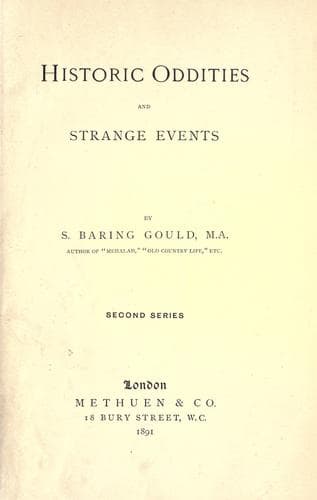
Historic Oddities and Strange EventsBaring-Gould, S. (Sabine)
History
Historic Oddities and Strange Events
Baring-Gould, S. (Sabine)
History; Mysticism; Patarines
As soon as the Duke was dead the dowager Duchess determined to enjoy
life. She had a pleasure yacht built, placed in command of it an officer
who had served in the navy, fitted it up with every luxury, sailed for
Italy, and visited Rome, where the Pope and the cardinals received her
with great courtesy. Indeed, she was given up one of the palaces of the
cardinals for her residence. Whilst she was amusing herself in Italy
something happened in England that was destined to materially spoil her
happiness. Anne Craddock was still alive, the sole witness of her
marriage that survived. She was in bad circumstances, and applied to Mr.
Field for pecuniary relief. He refused it, but the Duchess sent to offer
her twenty guineas per annum. This Anne Craddock refused, and gave
intimation to Mr. Evelyn Meadows that she had information of importance
which she could divulge.
When Mr. Meadows heard what Anne Craddock had to say, he set the
machinery of the law in motion to obtain the prosecution of the Duchess,
in the hopes of convicting her of bigamy, and then of upsetting the will
of the late Duke in her favour. A bill of indictment for bigamy was
preferred against her; the bill was found, Mr. Field had notice of the
procedure, and the Duchess was advised to return instantly to England
and appear to the indictment, to prevent an outlawry.
At this time--that is, in 1775--the Earl of Bristol died without issue,
and Augustus John, her first husband, succeeded to the title.
The anxieties of the Duchess were not confined to the probable issue of
the trial. Samuel Foote, the comedian, took a despicable advantage of
her situation to attempt to extort money from her. He wrote a farce,
entitled "A Trip to Calais," in which he introduced her Grace under the
sobriquet of Lady Kitty Crocodile, and stuffed the piece with
particulars relative to the private history of the Duchess, which he had
obtained from Miss Penrose, a young lady who had been about her person
for many years. When the piece was finished, he contrived to have it
communicated to her Grace that the Haymarket Theatre would open with the
entertainment in which she was held up to ridicule and scorn. She was
alarmed, and sent for Foote. He attended with the piece in his pocket.
She desired him to read a part of it. He obeyed; and had not read far
before she could no longer control herself, but, starting up in a rage,
exclaimed, "This is scandalous, Mr. Foote! Why, what a wretch you have
made me!" After a few turns round the room, she composed herself to
inquire on what terms he would suppress the play. Foote had the
effrontery to demand two thousand pounds. She offered him fourteen, then
sixteen hundred pounds; but he, grasping at too much, lost all. She
consulted the Duke of Newcastle, and the Lord Chamberlain was apprised
of the circumstances, and his interference solicited. He sent for the
manuscript copy of the "Trip to Calais," perused, and censured it. In
Public-domain text, read in full here on John Shaqi.
Reviews
Reviews
No reviews yet
Be the first to share your thoughts on this work.
Join the Discussion
Join the discussion
Sign in to leave a comment or review.
Sign InorCreate an account