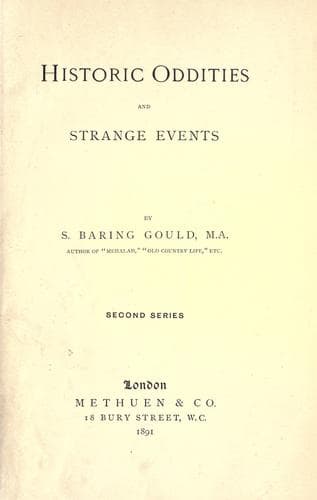
Historic Oddities and Strange EventsBaring-Gould, S. (Sabine)
History
Historic Oddities and Strange Events
Baring-Gould, S. (Sabine)
History; Mysticism; Patarines
On December 16th, two poor women went out of Perleberg to a little fir
wood in the direction of Quitzow, to pick up broken sticks for fuel.
There they found, a few paces from a path leading through the wood,
spread out on the grass, a pair of trousers turned inside out. On
turning them back they observed that they were stained on the outside,
as if the man who had worn them had lain on the earth. In the pocket was
a paper with writing on it; this, as well as the trousers, was sodden
with water. Two bullet holes were in the trousers, but no traces of
blood about them, which could hardly have been the case had the bullets
struck a man wearing the trousers. The women took what they had found to
the burgomaster. The trousers were certainly those of the missing man.
The paper in the pocket was a half-finished letter from Mr. Bathurst to
his wife, scratched in pencil, stating that he was afraid he would never
reach England, and that his ruin would be the work of Count
d'Entraigues, and he requested her not to marry again in the event of
his not returning.
The English Government offered £1,000 reward, and his family another
£1,000; Prince Frederick of Prussia, who took a lively interest in the
matter, offered in addition 100 Friedrichs d'or for the discovery of the
body, or for information which might lead to the solution of the
mystery, but no information to be depended upon ever transpired. Various
rumours circulated; and Mrs. Thistlethwaite, the sister of Benjamin
Bathurst, in her Memoirs of Dr. Henry Bathurst, Bishop of Norwich,
published by Bentley in 1853, gives them. He was said to have been lost
at sea. Another report was that he was murdered by his valet, who took
an open boat on the Elbe, and escaped. Another report again was that he
had been lost in a vessel which was crossing to Sweden and which
foundered about this time. These reports are all totally void of truth.
Mrs. Thistlethwaite declares that Count d'Entraigues, who was afterwards
so cruelly murdered along with his wife by their Italian servant, was
heard to say that he could prove that Mr. Bathurst was murdered in the
fortress of Magdeburg. In a letter to his wife, dated October 14, 1809,
Benjamin Bathurst said that he trusted to reach home by way of Colberg
and Sweden. D'Entraigues had been a French spy in London; and Mrs.
Thistlethwaite says that he himself told Mrs. Bathurst that her husband
had been carried off by _douaniers-montés_ from Perleberg to Magdeburg,
and murdered there. This it is hard to believe.
Thomas Richard Underwood, in a letter from Paris, November 24, 1816,
says he was a prisoner of war in Paris in 1809, and that both the
English and French there believed that the crime of his abduction and
murder had been committed by the French Government.
Public-domain text, read in full here on John Shaqi.
Reviews
Reviews
No reviews yet
Be the first to share your thoughts on this work.
Join the Discussion
Join the discussion
Sign in to leave a comment or review.
Sign InorCreate an account