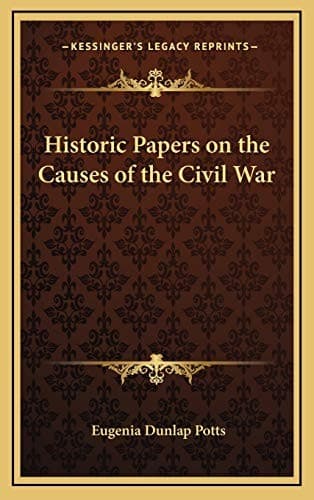
Historic Papers on the Causes of the Civil War — John Shaqi
Historic Papers on the Causes of the Civil WarPotts, Eugenia Dunlap
History
Historic Papers on the Causes of the Civil War
Potts, Eugenia Dunlap
Confederate States of America; Slavery -- United States; United States -- History -- Civil War, 1861-1865
Fitting environment, we add, for the gorgeous residences, notably
in Georgia and South Carolina, built by the nobility and gentry of
the republic, and inherited by the descendants of the old colonial
aristocracy. What wonder, that they held themselves aloof from the
manual laborer, black or white, and that they were uncontaminated by
the attrition of commercial competition. In the summer the family sought
the cooler climate of old Kentucky or Virginia, or farther north to
Saratoga, Long Branch, or some one of the then attractive resorts. They
travelled in state, frequently bringing the family coach, and never
without a retinue of servants. What a sensation they made! And money
flowed like water. The young men, rich and idle, paid court to pretty
girls, sure of a welcome from both parents and daughters, for to marry a
Southern planter was to achieve a social victory for all time to come.
The mechanical and athletic age had not yet dawned. The accepted escort
must be a professional man, or else lord of a domain such as I have
described. Pride and prejudice blinded judgment, and the aristocracy
of merit alone was unappreciated.
And yet the Southern woman, even of great wealth, could not afford
to be idle. She was not, save in exceptional cases, the useless,
half-educated, irresponsible creature she has been represented. Some
there are always and everywhere whose lives are given over to fads,
fancies and frivolities. But the true mothers were priestesses at the
home altar, and kept the sacred fires bright and burning. Their duty
was to keep others busy, and to direct and oversee the vast domestic
machinery of the home.
Their views were somewhat narrow, for as yet the bright sun of woman's
emancipation was barely peeping over the horizon. Their minds did not
grasp the vexed questions of theology, politics, or economics. They
accepted the faith of their fathers, and shifted all burdens to stronger
shoulders. They were eminently religious and charitable. Ways and
means were at hand, and they did not bother their brains with isms and
ologies. Regular attendance upon the nearest church, and reverence for
the clergy, were prominent in their creed.
Education for the masses was not provided, as it is now; but the
majority of the better class were finely educated, either at Northern
schools, or by the governess, and tutor at home. In many cases where the
wife was widowed, she nobly and intelligently arose to the management of
business affairs. If misfortune came, and the woman felt obliged to earn
a livelihood, it did not occur to her to seek it behind a counter or in
a workshop as we do in this generation. She was inclined to walk in the
old paths, and follow old customs. They believed their own skies were
bluest, their own cornfields greenest, their tobacco finest, their
cotton the whitest on earth. They were devoted to old friends, to old
manners and customs, and gloried in their birthright.
Public-domain text, read in full here on John Shaqi.
Reviews
Reviews
No reviews yet
Be the first to share your thoughts on this work.
Join the Discussion
Join the discussion
Sign in to leave a comment or review.
Sign InorCreate an account