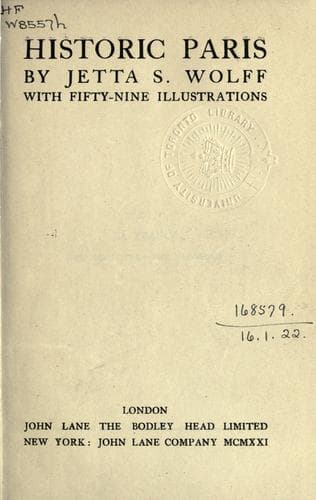
Paris (France) -- Description and travel; Paris (France) -- History
The legend telling us the great Paris Market was first called “les
Alles”--no “H”--because everybody _y allait_, i.e. went there, need not
be taken seriously. Even in remote mediæval times the markets had some
covered premises or “Halles.” The earliest Paris market of which we have
record takes us back to the year 1000, that momentous year predicted by
sooth-sayers for the end of the world; few sowings, therefore, had been
made the preceding season. The market stalls of that year were but
scantily furnished. That ancient market lying along the banks of the
Seine in the vicinity of the present Place St-Michel, and its successor
on what was then Place de Grève (_see_ p. 95) went by the curious name
Palu. In ancient days, under Louis-le-Gros, the site of the immense
erection and market-square we see now was known of old as _le terrain
des champeaux_--the territory of little fields--land owned in part by
the King, in part by ecclesiastical authorities, and bought for the
great market in the twelfth century. The sale of herrings, wholesale and
retail, goes on to-day on the very site set apart for fishmongers in the
time of St. Louis. Rue Baltard, running through the centre of the
pavilions, records the name of the architect of the present structure,
which dates from 1856. Rue Antoine-Carême records the name of Napoléon
I’s cook. Ancient streets surround us here on every side, old houses,
curious old signs. Rue Berger is made up of several ancient streets
united. The part of Rue Rambuteau bordering les Halles lies along the
line of four thirteenth-century streets known of yore by old-world
names. Rue des Halles, leading up to the Markets from the Rue Rivoli, a
modern thoroughfare (1854), made along the course of ancient streets,
has curious old streets leading into it: Rue des Déchargeurs, a
characteristic name, was opened in 1310. The short Rue du Plat d’Étain
opening out of it dates from 1300, when it was Rue Raoul Tavernier. Rue
de la Ferronnerie, extremely narrow at that period, is noted as the
scene of the assassination of Henri IV in front of a house on the site
of No. 11 (14 May, 1610). From the days of Louis IX the street was, as
its name implies, the resort of ironmongers. Good old ironwork is still
seen on several of the houses. Rue Courtalon (thirteenth century) is
entirely made up of ancient houses. Rue de la Lingerie, formerly Rue des
Gantiers, was a well-built street in the time of Henri II, but most of
the houses seen there now are modern. Rue Prouvaires--from _provoire_,
old French for _prêtres_--thirteenth century, is referred to in the time
of Louis IX as one of the finest streets of Paris. It extended formerly
to the church St-Eustache. Of the old streets once along the course of
the modern Rue du Pont-Neuf all traces have been swept away.
[Illustration: PORTAIL DE ST-EUSTACHE]
Public-domain text, read in full here on John Shaqi.
Reviews
Reviews
No reviews yet
Be the first to share your thoughts on this work.
Join the Discussion
Join the discussion
Sign in to leave a comment or review.
Sign InorCreate an account