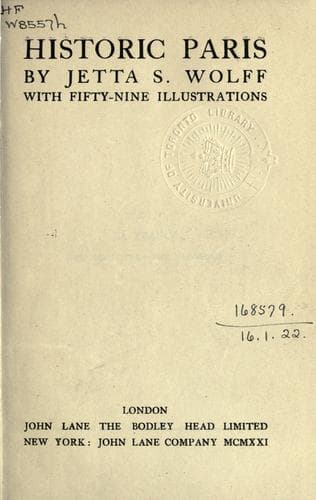
Paris (France) -- Description and travel; Paris (France) -- History
The big hall of that day and other adjacent halls and passages were
burnt down more than once in olden times, and burnt down again in 1871,
when the Communards wrought havoc on so many fine old buildings of their
city. The most thrilling incidents, the most stirring events in the
history of the Nation had some point of connection with that ancient
palace--often a culminating point. And within those grim walls where the
destinies of men and women of all conditions and ranks were determined,
where tragedy held its own, scenes in lighter vein were not unknown in
ancient days. Mystery plays were often given there, and every year in
the month of May, reputed a “merry month,” even in the Palais de
Justice, the company of men of law known as the “basoche,” planted a
May-tree in the courtyard before the great entrance doors--hence the
name “la Cour de Mai.” It is a tragic courtyard despite its name, for
the Conciergerie prison opened into it; through the door of what is now
the Buvette du Palais--a refreshment-room--men and women condemned to
death passed, in Revolution days, while other men and women, women
chiefly, crowded on the broad steps above to see the laden _charrettes_
start off for the place of execution.
[Illustration: LA SAINTE-CHAPELLE]
The Sainte-Chapelle, that wondrous piece of purest Gothic architecture,
the work of Pierre de Montereau (1245-48) built for the preservation of
sacred relics brought by Louis IX on his return from the Holy Land,
vividly recalls the days when the palace was a royal habitation. Its
upper story was in direct communication with the royal dwelling-rooms;
the lower story was for the palace servants and officials. During the
Revolution the chapel was devastated and used as a club and a
flour-store. The Chambre des Comptes, a beautiful old building in the
courtyard of the Sainte-Chapelle, was destroyed by fire in 1737. Its big
arch was saved and forms part of the Musée Carnavalet (_see_ p. 81). A
chief feature of the _chapelle_ is its exquisite stained glass.
The enlarging of the Palais in recent times (1908) swept away
surrounding relics of bygone ages. Some vestiges of past days still
remain in Rue de Harlay opposite the Palais, to the west--Nos. 20, 54,
52, 68, 74. The buildings of the boulevard du Palais and Rue de Lutèce,
on its eastern side, arrondissement IV, are all modern on ancient
historic sites.
Public-domain text, read in full here on John Shaqi.
Reviews
Reviews
No reviews yet
Be the first to share your thoughts on this work.
Join the Discussion
Join the discussion
Sign in to leave a comment or review.
Sign InorCreate an account