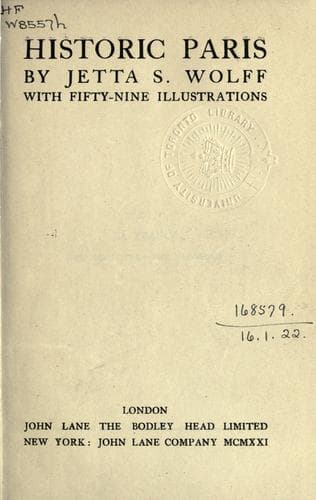
Paris (France) -- Description and travel; Paris (France) -- History
The Lycée Louis-le-Grand, Rue St-Jacques, on the site of four colleges
of bygone ages, dates in its foundation from 1550, rebuilt 1814-20,
restored 1861-85. In the court we see some of the ancient walls. It has
borne different names characteristic of the different periods of the
history of France. It began as the Collège de Clermont, from its
founder, the bishop; in 1682 it took the name of the King,
Louis-le-Grand. In 1792 it became Collège de l’Égalité; in 1800, Le
Pyrtanée; Lycée Imperial in 1802; Collège Royal-Louis-le-Grand in 1814;
Lycée Descartes in 1848, to revert to its present designation in 1849.
Many of the most eminent men of the eighteenth and nineteenth centuries
were pupils there.
The Collège Ste-Barbe built in the sixteenth century was added to
Louis-le-Grand in 1764. Its tower goes by the name Tour Calvin, for this
was the Huguenot quarter. Here many of the persecuted Protestants were
in hiding at the Massacre of St. Bartholomew. Yet it was at Ste-Barbe
that Ignatius Loyola was educated.
Close around Lycée Louis-le-Grand and the Collège de France, we find a
number of twelfth-and thirteenth-century streets condemned to
demolition, some of their houses already razed, those that remain
showing many interesting relics. Rue du Cimetière-St-Benoît, which
bordered the cemetery erewhile there; Rue Fromantel, the name a
corruption of _froid mantel_, or _manteau_, with its interesting
old-world dwellings; Impasse Chartrière, where at No. 2 we see an old
sign and a niche of the time of Henri IV, who was wont to visit his
“belle Gabrielle” here. No. 11 was, it is said, the entrance to the
King’s stables. At the junction of Rue Lanneau four streets form the
quadrangle where was erewhile the well “Certain,” so named after the
vicar of the old church St-Hilaire, once close by, discovered beneath
the roadway in 1894. Roman remains of great interest were found at that
time below the surface of all these streets. Rue Valette, eleventh
century, was once Rue des Sept Voies, for seven thoroughfares met there.
At No. 2, in the billiard-room of the old inn, we find vestiges of the
church St-Hilaire, once there. No. 19 dates from the fourteenth century,
and in the seventeenth century was a meeting-place of the Huguenots who
hid in its Gothic two-storied cellars. In Rue Laplace lived Jean de
Meung, author of _Le Roman de la Rose_. At No. 12 we see the entrance of
a vanished college, next door to which was the Collège des Écossais.
L’École Polytechnique stands on the site of the college founded in 1304
by Jeanne de Navarre, wife of Philippe le Bel, for seventy poor
scholars. It was rebuilt in the fifteenth century. The last vestiges of
that rebuilding, a beautiful Gothic chapel, were swept away in 1875.
Traces of a Roman cemetery were found in 1906. The present structure
dates from the eighteenth century, the work of Gabriel. The house of the
Général-Commandant is the ancient Collège de Boncourt, founded in 1357.
Public-domain text, read in full here on John Shaqi.
Reviews
Reviews
No reviews yet
Be the first to share your thoughts on this work.
Elsewhere in the archive
Join the Discussion
Join the discussion
Sign in to leave a comment or review.
Sign InorCreate an account