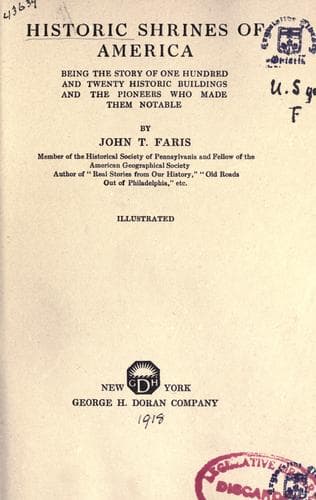
Historic Shrines of America: Being the Story of One Hundred and Twenty Historic Buildings and the Pioneers Who Made Them NotableFaris, John T. (John Thomson)
History
Historic Shrines of America: Being the Story of One Hundred and Twenty Historic Buildings and the Pioneers Who Made Them Notable
Faris, John T. (John Thomson)
Historic buildings -- United States; United States -- Biography
Less than a week later, within a mile of his own house, he was
surprised by the enemy near Paoli, in consequence, it is said, of the
act of an inn-keeper who betrayed Wayne's presence to the British. The
result was the only defeat of his brilliant career. Eighty of his men
were killed. The engagement has been called "the Paoli Massacre,"
because of the conduct of the victors. Wayne escaped. A squad of
soldiers searched for him at Waynesborough. When they could not find
him in the house, they thrust their bayonets into the great boxwood
bush that is still to be seen in the rear of the mansion.
Because some said that the General was responsible for the defeat, he
demanded a court-martial. The court-martial was held soon after, and
he was acquitted with the highest honor, and was declared to be "an
active, brave, and vigilant officer."
Washington's letters and orderly book are full of references to Wayne.
He was a trusted commander, and his advice was followed many times. He
it was who first proposed that the army should "hut" during the winter
of 1776-77, some twenty miles from Philadelphia. He was always eager
to do his Commander's bidding. On one occasion, when he was in
Philadelphia, on his way to greet his family, he was met by a fast
rider who handed him a despatch in which Washington said, "I request
that you join the army as soon as you can."
During his long absence from Waynesborough his wife Polly and his
children were continually in his thoughts. Once he wrote:
"I am not a little anxious about the education of our girl
and boy. It is full time that Peggy should be put to dancing
school. How does she improve in her writing and reading? Does
Isaac take learning freely? Has he become fond of school?"
Just before the storming of Stony Point, he prepared for death,
sending to a friend a letter which was not to be opened until the
author was dead. The letter said:
"I know that your friendship will induce you to attend to the
education of my little son and daughter. I fear that their
mother will not survive this stroke. Do go to her."
On the way up the mount he was grievously wounded and fell senseless.
Soon he roused himself and cried, "Lead me forward.... Let me die in
the fort." Several hours later he was able to send word to Washington,
"The fort and garrison are ours."
In this spirit he served through the war. And when the action was won
he continued to fight for his country. On February 6, 1796, Claypool's
_Daily American Advertiser_ told of his return from his successful
campaign against the Indians of Ohio:
"Four miles from the city, he was met by the entire Troop of
Philadelphia Light Horse, and escorted by them to town. On
his crossing the Schuylkill, a salute of fifteen guns was
fired from the Centre-square, by a party of Artillery. He was
ushered into the city by the ringing of bells and other
demonstrations of joy."
Public-domain text, read in full here on John Shaqi.
Reviews
Reviews
No reviews yet
Be the first to share your thoughts on this work.
Elsewhere in the archive
Join the Discussion
Join the discussion
Sign in to leave a comment or review.
Sign InorCreate an account