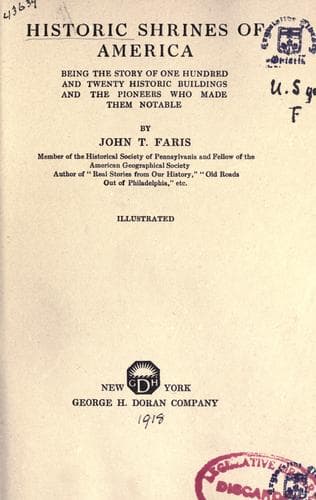
Historic Shrines of America: Being the Story of One Hundred and Twenty Historic Buildings and the Pioneers Who Made Them NotableFaris, John T. (John Thomson)
History
Historic Shrines of America: Being the Story of One Hundred and Twenty Historic Buildings and the Pioneers Who Made Them Notable
Faris, John T. (John Thomson)
Historic buildings -- United States; United States -- Biography
The Home of General Anthony Wayne,
Born in this House, January 1, 1745.
Died at Erie, Pennsylvania, December 15, 1796.
A Leader of the American Revolution in
Pennsylvania and a soldier distinguished
for his
Services at Brandywine, Germantown,
Valley Forge,
Monmouth, Stony Point, and Yorktown.
Subdued the Indians of Ohio, 1794.
Commander-in-Chief of the
United States Army 1792-1796.
Marked by the Chester County Historical
Society.
To this record the statement might have been added that General
Lafayette visited the home of his old commander when he was in the
United States in 1824. Reverently the General bowed his head in
Wayne's favorite sitting-room, to the right of the entrance hall,
where nothing had been disturbed since the death of the patriot. The
furnishings and ornaments of the room are the same to-day as then.
Anthony Wayne was a delegate to several of the conventions which took
the preliminary steps leading to the Revolutionary War. In 1775 he was
a member of the Committee of Safety, and in the same year he organized
a regiment of "minute men" in Chester County.
His first active service was as colonel with troops sent to Canada in
January, 1776, and from November, 1776, to April, 1777, as commander
of twenty-five hundred men at Ticonderoga. "It was my business to
prevent a junction of the enemy's armies and ... to keep at bay their
whole Canadian force," he wrote in a private letter.
Here, in the midst of difficulties with soldiers who wanted to desert,
he heard that the British were threatening Waynesborough. But, like a
true soldier, he stuck to his work, and urged his wife to be brave.
"Should you be necessitated to leave East-town, I doubt not but you'll
meet with hospitality in the back parts of the Province," he wrote to
her.
His fidelity and resourcefulness were recognized in February, 1777, by
a commission as brigadier general. Washington, who was then in New
Jersey, wrote to him a little later, saying that his presence with him
was "materially needed," to guard the country between West Point and
Philadelphia. And when the British fleet sailed out of New York
Harbor, Washington sent him to Chester, to organize the militia of
Pennsylvania. A few weeks later he was in charge of a division at
Brandywine. Historians say that his steadfastness on the left
prevented the advance of Knyphausen, and saved the right from entire
destruction.
Public-domain text, read in full here on John Shaqi.
Reviews
Reviews
No reviews yet
Be the first to share your thoughts on this work.
Elsewhere in the archive
Join the Discussion
Join the discussion
Sign in to leave a comment or review.
Sign InorCreate an account