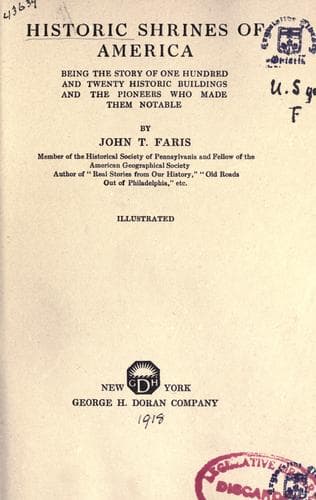
Historic Shrines of America: Being the Story of One Hundred and Twenty Historic Buildings and the Pioneers Who Made Them NotableFaris, John T. (John Thomson)
History
Historic Shrines of America: Being the Story of One Hundred and Twenty Historic Buildings and the Pioneers Who Made Them Notable
Faris, John T. (John Thomson)
Historic buildings -- United States; United States -- Biography
When brought before Lord Cornbury, Makemie said: "We have Liberty from
an Act of Parliament, made the first year of the Reign of King William
and Queen Mary, which gave us Liberty, with which Law we have
complied."
But Lord Cornbury replied: "No one shall Preach in my Government
without my Licence.... That Law does not extend to the American
Plantations, but only to England.... I know, for I was at Making
thereof.... That Act of Parliament was made against Strowling
Preachers, and you are such, and shall not Preach in my Government."
Makemie again challenged Lord Cornbury to show "any Pernicious
Doctrine in the Confession of Faith of the Presbyterian Church." Later
he refused to give "Bail and Security to Preach no more."
"Then you must go to Gaol," his Lordship said.
On January 23 another warrant was given to the High Sheriff of New
York. He was told "to safely keep till further orders" the prisoners
committed to him.
From the prison Makemie sent a petition asking to know the charge, and
demanding a speedy trial. Later the prisoner was released on habeas
corpus proceedings.
At the trial, where Makemie conducted his own defence, he read Chapter
23 of the Westminster Confession of Faith, as a complete reply to the
charge that he believed what incited the people to disregard the
authority of the king.
The jury brought in a verdict of "not guilty," but Makemie was obliged
to pay the costs, including the fees of the Court Prosecutor, which
amounted to twelve pounds. The total cost of the trial, including the
expense of a trip from his home in Maryland, made necessary by a
recess in the trial, was more than eighty pounds.
A few months later Makemie died. It was felt by those who knew him
that the trying experiences at New York hastened his end.
He had not lived in vain. His struggles for religious liberty were to
bear rich fruit before many years.
Henry van Dyke wrote a sonnet to the memory of Francis Makemie, which
was read on May 14, 1908, when the monument to the memory of the
pioneer was unveiled:
"To thee, plain hero of a rugged race,
We bring a meed of praise too long delayed!
Thy fearless word and faithful work have made
Of God's Republic a firmer resting-place
In this New World: for thou hast preached the grace
And power of Christ in many a forest glade,
Teaching the truth that leaves men unafraid
Of frowning tyranny or death's dark face.
"Oh, who can tell how much we owe to thee,
Makemie, and to labor such as thine,
For all that makes America the shrine
Of faith untrammelled and of conscience free?
Stand here, grey stone, and consecrate the sod
Where rests this brave Scotch-Irish man of God."
[Illustration: DOUGHOREGAN MANOR, NEAR ELLICOTT CITY, MD.
_Photo by James F. Hughes Company, Baltimore_
See page 216]
XLVII
DOUGHOREGAN MANOR, NEAR ELLICOTT CITY, MARYLAND
Public-domain text, read in full here on John Shaqi.
Reviews
Reviews
No reviews yet
Be the first to share your thoughts on this work.
Elsewhere in the archive
Join the Discussion
Join the discussion
Sign in to leave a comment or review.
Sign InorCreate an account