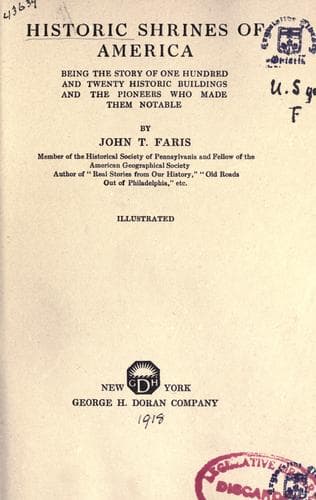
Historic Shrines of America: Being the Story of One Hundred and Twenty Historic Buildings and the Pioneers Who Made Them NotableFaris, John T. (John Thomson)
History
Historic Shrines of America: Being the Story of One Hundred and Twenty Historic Buildings and the Pioneers Who Made Them Notable
Faris, John T. (John Thomson)
Historic buildings -- United States; United States -- Biography
WHOSE OWNER WAS THE LAST SURVIVING SIGNER OF THE DECLARATION OF
INDEPENDENCE
It is true that when Charles Carroll was about to sign his name to the
Declaration of Independence he added the words, "of Carrollton," but
the story that he added the words there that he might be distinguished
from a second Charles Carroll is an error; he had been writing his
name thus since 1765. It would have been just as true a description if
he had used the name of another of the numerous Carroll estates,
Doughoregan Manor, but the designation he chose was simpler. At any
rate he could not spell it in so many ways as the name of the family
estate where he lived and died. Letters written by him at different
periods show such diverse spellings as "Doeheragen," "Doohoragen,"
"Dooheragon," and "Dougheragen," before he settled down to
"Doughoregan."
Doughoregan Manor, which was named for one of the O'Carroll estates in
Ireland, is one of the most ancient family seats in Maryland. In 1688
Charles Carroll, I, came over from England. He became a large landed
proprietor, in part as a result of his appeal to the king of England
for a part in the estate of the O'Carrolls of King's County, Ireland.
The king satisfied the claim by offering him 60,000 acres of land in
the Colonies. His heir was Charles Carroll, II, who was born in 1702.
Fifteen years later Doughoregan Manor was built, and twenty-seven
years later Charles Carroll, II, and his brother Daniel sold sixty
acres of land which became the site of old Baltimore.
Charles Carroll, II, divided his time between Doughoregan Manor and
the Carroll Mansion in Annapolis, his town house. Here was born, in
1737, Charles Carroll, III, the Signer. Most of the education of this
heir to the vast estate of Charles Carroll, II, was secured in France.
He was in Paris when his father wrote to him, in 1764, telling him of
the large property that was to come to him. After speaking of this in
detail, he concluded:
"On my death I am willing to add my Manor of Doughoregan,
10,000 acres, and also 1,425 Acres called Chance adjacent
thereto, on the bulk of which my negroes are settled. As you
are my only child, you will, of course, have all the residue
of my estate at my death."
When the estate of his father finally came into his hands, Charles
Carroll, III, was the richest man in Maryland. That he knew how to
handle such a large property he showed by a letter which he wrote to
his son, Charles Carroll, IV, on July 10, 1801:
"He who postpones till to-morrow what can and ought to be
done to-day, will never thrive in this world. It was not by
procrastination this estate was acquired, but by activity,
thought, perseverance, and economy, and by the same means it
must be preserved and prevented from melting away."
Public-domain text, read in full here on John Shaqi.
Reviews
Reviews
No reviews yet
Be the first to share your thoughts on this work.
Elsewhere in the archive
Join the Discussion
Join the discussion
Sign in to leave a comment or review.
Sign InorCreate an account