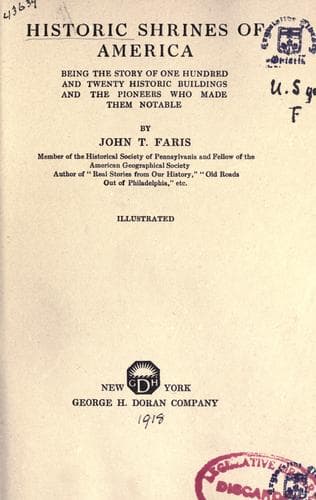
Historic Shrines of America: Being the Story of One Hundred and Twenty Historic Buildings and the Pioneers Who Made Them NotableFaris, John T. (John Thomson)
History
Historic Shrines of America: Being the Story of One Hundred and Twenty Historic Buildings and the Pioneers Who Made Them Notable
Faris, John T. (John Thomson)
Historic buildings -- United States; United States -- Biography
The south wing was completed under the guidance of Benjamin Henry
Latrobe, who also reconstructed the north wing and connected the two
wings by a wooden bridge. That the building was far from satisfactory
is evident from an article in the _National Intelligencer_ of December
2, 1813, which spoke with disgust of the wooden passageway as well as
of the piles of debris on every hand.
In less than a year after the printing of the criticism, conditions
were far worse, for the British troops came to Washington on August
24, 1814. They piled furniture in the hall of the House, and set fire
to it. The wooden bridge that connected the wings burned like tinder.
In a little while nothing was left but the walls. "The appearance of
the ruins was perfectly terrifying," Architect Latrobe wrote.
Thus was fulfilled in a striking way the prophecy made by John
Randolph when he pleaded with Congress not to make war on Great
Britain, "All the causes urged for this war will be forgotten in your
treaty of peace, and possibly this Capitol may be reduced to ashes."
The next session of Congress was held in the Union Pacific Hotel, but
by December, 1815, there was ready a three-story building, erected by
popular subscription, which Congress used for three years, paying for
it an annual rental of $1,650. This was called "The Brick Capitol."
Of course efforts were made to remove the Capital to another location,
but Congress made appropriation for the reconstruction of the Capitol
on the old site. Work was begun almost at once, and was continued
until 1830, when the wings had been rebuilt as well as the rotunda and
centre structure. In general appearance the building was the same as
before the fire, but marble instead of sandstone was used for
colonnades and staircases and floors. The beautiful capitals of the
marble pillars were carved in Italy or prepared by workmen brought
from Italy.
During the latter part of this period the rotunda was used for all
sorts of exhibitions. Once a panorama of Paris was shown there, an
admission fee of fifty cents being charged. Exhibits of manufactured
goods were made in this "no man's land," over which nobody seemed to
have jurisdiction. In 1827 a congressman spoke in the House of the
fact that "triangles of steel to take the place of bells, stoves, stew
pans, pianos, mouse traps, and watch ribbons were marked with prices
and sundry good bargains were driven." The general public felt that
they had a right even to the hall of the House; frequently popular
meetings were held there.
Public-domain text, read in full here on John Shaqi.
Reviews
Reviews
No reviews yet
Be the first to share your thoughts on this work.
Elsewhere in the archive
Join the Discussion
Join the discussion
Sign in to leave a comment or review.
Sign InorCreate an account