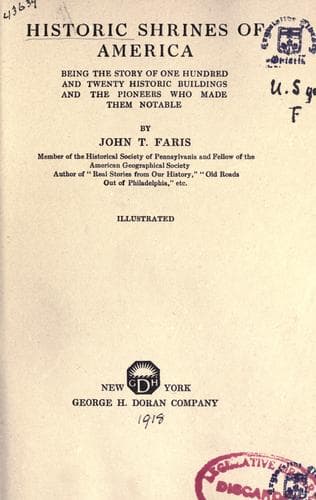
Historic Shrines of America: Being the Story of One Hundred and Twenty Historic Buildings and the Pioneers Who Made Them NotableFaris, John T. (John Thomson)
History
Historic Shrines of America: Being the Story of One Hundred and Twenty Historic Buildings and the Pioneers Who Made Them Notable
Faris, John T. (John Thomson)
Historic buildings -- United States; United States -- Biography
Neither Congress nor the country was satisfied with this solution of
the difficulty. After years of discussion, in September, 1789, one
house of Congress fixed on the Falls of the Susquehanna in
Pennsylvania as the permanent site. The Senate amended their proposal
by suggesting Germantown, Pennsylvania.
This action was reconsidered and a long dispute followed. Finally, in
1790, the site on the Potomac was selected, and Congress was ready to
provide for the building of "a palace in the woods."
President Washington and Vice-President Adams disagreed as to the
location of the Capitol building. John Adams wished to see it the
centre of a quadrangle of other public buildings, but Washington urged
that Congress should meet in a building at a distance from the
President's house and all other public buildings, that the lawmakers
might not be annoyed by the executive officers.
The invitation to architects to present plans for the Capitol was made
in March, 1792, five hundred dollars being promised for the best plan.
None of the sixteen designs submitted were approved. Later two men,
Stephen L. Hallet and Dr. William Thornton, offered such good plans
that it was not easy to decide between them. The difficulty was solved
by acceptance of Thornton's design and the engagement of Hallet as
supervising architect at a salary of two thousand dollars a year.
This arrangement was not satisfactory; it became necessary to replace
Hallet first by George Hadfield, then by James Hoban, the architect of
the White House. Under his charge the north wing was completed in
1800.
The proceeds from the sale of lots in the new city proved woefully
inadequate for the expenses of the building. Congress authorized a
loan of eight hundred thousand dollars, but this loan could not be
disposed of until Maryland agreed to take two-thirds of the amount, on
condition that the commissioners in charge of the work add their
personal guarantee to the government's promise to pay.
Congress was called to hold its first meeting in the Capitol north
wing on November 17, 1800. A few months earlier the government
archives had been moved from New York. These were packed in ten or
twelve boxes, and were shipped on a packet boat, by sea. The arrival
of the vessel was greeted by the three thousand citizens of
Washington, who rang bells, cheered, and fired an old cannon in
celebration of the event.
At that time the foundation for the dome had been laid, and the walls
of the south wing had been begun. Later a temporary brick building was
erected for the House, on a portion of the site of the south wing. The
legislators called the building "The Oven."
Public-domain text, read in full here on John Shaqi.
Reviews
Reviews
No reviews yet
Be the first to share your thoughts on this work.
Elsewhere in the archive
Join the Discussion
Join the discussion
Sign in to leave a comment or review.
Sign InorCreate an account