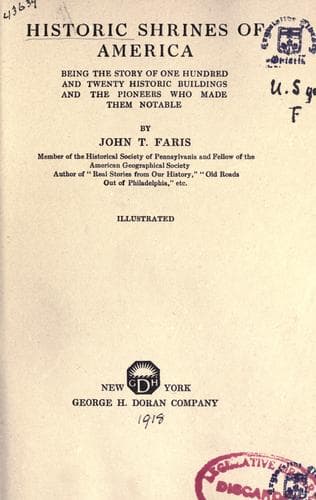
Historic Shrines of America: Being the Story of One Hundred and Twenty Historic Buildings and the Pioneers Who Made Them NotableFaris, John T. (John Thomson)
History
Historic Shrines of America: Being the Story of One Hundred and Twenty Historic Buildings and the Pioneers Who Made Them Notable
Faris, John T. (John Thomson)
Historic buildings -- United States; United States -- Biography
"The General's house is rather warm, snug, convenient and
useful, than ornamental. The size is what ought to suit a man
of about two or three thousand a year in England. The
out-offices are good and seem to be not long built; and he
was making more offices at each wing to the front of the
house, which added more to ornament than to real use. The
situation is high, and commands a beautiful prospect of the
river which parts Virginia and Maryland, but in other
respects the situation seems to be out of the world, being
chiefly surrounded by woods, and far from any great road or
thoroughfare.... The General's lady is a hearty, comely,
discreet, affable woman, some few years older than
himself.... The General's house is open to poor travellers as
well as rich, he gives diet and lodging to all that come that
way, which indeed cannot be many, without they go out of
their way on purpose...."
A visitor of January 19, 1785, was Elkanah Watson. In his diary
Washington wrote simply that Mr. Watson came in and stayed all night;
and that he went away after breakfast next morning. But Mr. Watson had
a fuller account to give:
"I found him at table with Mrs. Washington and his private
family, and was received in the native dignity and with that
urbanity so peculiarly combined in the character of a soldier
and eminent private gentleman. He soon put me at ease.... The
first evening I spent under the wing of his hospitality, we
sat a full hour at table by ourselves, without the least
interruption, after the family had retired. I was extremely
oppressed by a severe cold and excessive coughing, contracted
by the exposure of a harsh winter journey. He pressed me to
use some remedies, but I declined doing so. As usual after
retiring, my coughing increased. When some time had elapsed,
the door of my room was gently opened, and on drawing my
bed-curtains, to my utter astonishment, I beheld Washington
himself, standing at my bedside, with a bowl of hot tea in
his hand."
The following May Rev. Thomas Coke and Bishop Francis Asbury were
welcomed to Mt. Vernon. "The General's seat is very elegant," Mr. Coke
wrote. "He is quite the plain, country-Gentleman." After dinner the
visitors presented to their host a petition for the emancipation of
the Negroes, "entreating his signature, if the eminence of his station
did not render it inexpedient for him to sign any petition."
Washington told his guests that he was "of their sentiments, and had
signified his thoughts on the subject to most of the great men of the
State; that he did not see it proper to sign the petition, but if the
Assembly took it into consideration, would signify his sentiments to
the Assembly by a letter."
An attractive picture of the General was given by Richard Henry Lee
after a visit to Mt. Vernon in November, 1785:
Public-domain text, read in full here on John Shaqi.
Reviews
Reviews
No reviews yet
Be the first to share your thoughts on this work.
Elsewhere in the archive
Join the Discussion
Join the discussion
Sign in to leave a comment or review.
Sign InorCreate an account