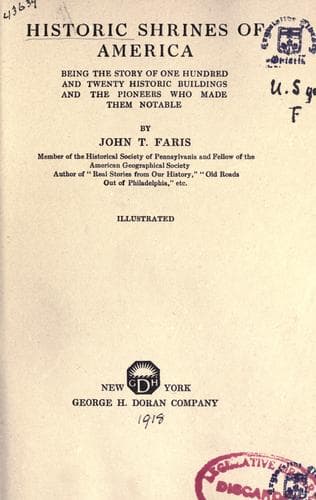
Historic Shrines of America: Being the Story of One Hundred and Twenty Historic Buildings and the Pioneers Who Made Them NotableFaris, John T. (John Thomson)
History
Historic Shrines of America: Being the Story of One Hundred and Twenty Historic Buildings and the Pioneers Who Made Them Notable
Faris, John T. (John Thomson)
Historic buildings -- United States; United States -- Biography
"When I was first introduced to him he was neatly dressed in
a plain blue coat, white Casimer waistcoat, and black
breeches and Boots, as he came from his farm. After having
sat with us some time he retired.... Later he came in again,
with his hair neatly powdered, a clean shirt on, a new plain
drab Coat, white waistcoat and white silk stockings."
John Hunter, who was with Colonel Lee, added his impression:
"The style of his house is very elegant, something like the
Prince de Conde's at Chantilly, near Paris, only not quite so
large; but it's a pity he did not build a new one at once, as
it has cost him nearly as much as repairing his old one....
It's astonishing what a number of small houses the General
has upon his Estate for his different Workmen and Negroes
to live in. He has everything within himself--Carpenters,
Bricklayers, Brewers, Blacksmiths, Bakers, etc., etc., and
even has a well assorted store for the use of his family and
servants."
While the repairs were still in progress, the ship _Mary_ arrived at
Alexandria, having a consignment for Washington from Samuel Vaughan, a
great admirer in London. This was a chimney-piece, wrought in Italy
from pure white and sienite marble, for the use of Mr. Vaughan. When
the mantel reached England the owner learned of the improvements then
in progress at Mt. Vernon. Without unpacking the mantel he sent it on
to America. When Washington received word of the arrival of the gift,
he wrote, "By the number of cases, however, I greatly fear it is too
elegant and costly for my room and republican style of living."
Nevertheless the mantel was installed in the mansion and became a
great delight to the household.
Washington's days at Mt. Vernon were interrupted by the renewed call
of his country. For much of the time for eight years he was compelled
to be absent, and when, at length, the opportunity came to resume the
free life on his estate, he had less than three years left. But these
years were crowded full of hospitality in the mansion and of joyous
work on the estate, and when, on December 14, 1799, he died as a
result of a cold caught while riding on the estate, he left it to his
"dearly beloved wife, Martha Washington."
For many years Mt. Vernon continued its hospitable career. Then came
years of neglect, when the mansion was falling into ruins. But in
1853-56 Miss Ann Pamela Cunningham of South Carolina appealed to the
women of the nation, and succeeded in organizing an association that
took over the estate, restored it to its original condition, furnished
it with Washington relics gathered from far and near, and opened it
for the visits of the reverent visitors to the city of Washington, who
continue their journey sixteen miles down the Potomac that they may
look on the scene that brought joy to the heart of the Father of his
Country.
Public-domain text, read in full here on John Shaqi.
Reviews
Reviews
No reviews yet
Be the first to share your thoughts on this work.
Elsewhere in the archive
Join the Discussion
Join the discussion
Sign in to leave a comment or review.
Sign InorCreate an account