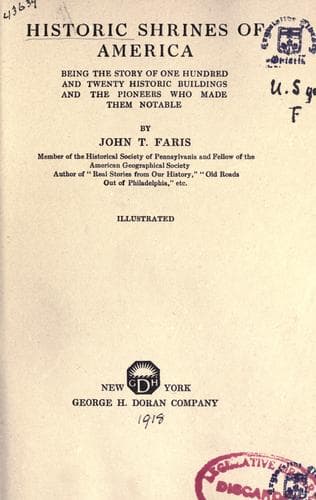
Historic Shrines of America: Being the Story of One Hundred and Twenty Historic Buildings and the Pioneers Who Made Them NotableFaris, John T. (John Thomson)
History
Historic Shrines of America: Being the Story of One Hundred and Twenty Historic Buildings and the Pioneers Who Made Them Notable
Faris, John T. (John Thomson)
Historic buildings -- United States; United States -- Biography
[Illustration: ARLINGTON, VIRGINIA
_Photo by H. P. Cook_
See page 246]
LIII
ARLINGTON, VIRGINIA
FROM WHICH ROBERT E. LEE WENT TO BATTLE FOR THE SOUTH
After the death of George Washington the Mt. Vernon family was
gradually broken up, one after another going elsewhere for a home.
George Washington Parke Custis, Washington's adopted son, and grandson
of Martha Washington, decided to build a home on a hill overlooking
the Potomac, opposite Washington City. There were eleven hundred acres
in the estate of which Arlington, the mansion he built in 1802, was
the central feature.
It has been said that the stately house is an adaptation of the Doric
temple at Paestum, near Naples. The roof of the great portico rests on
eight massive columns. The rooms within are of a size in keeping with
the magnificent portal.
Perhaps the plan was too ambitious for the Custis fortune. At any rate
the rooms on the south side of the hall were not completed. But it
was a famous house, nevertheless. Guests were many. They delighted to
look from the portico across the Potomac to Washington, where they
could see the government buildings slowly taking shape.
One of the favored guests was Robert E. Lee. His frequent visits led
to his marriage, in 1831, to Mr. Custis' daughter. At this time Lee
was a lieutenant in the United States Army. Mrs. Lee remained at
Arlington, waiting for the husband whose military duties enabled him
to spend only brief seasons with her and the growing family there.
During the years before the war visitors to the Capital City thronged
to Arlington. Some of them were interested in the many Washington
relics in the house. Chief among these was the bed on which Washington
died. Others came to the picnic grounds at Arlington Spring, which Mr.
Custis had opened for the pleasure of the people, building for the use
of all comers a great dining-hall, a dancing pavilion, and a kitchen.
One of these visitors told his impressions of Arlington:
"In front of the mansion, sloping toward the Potomac, is a
fine park of two hundred acres, dotted with groves of oak and
chestnut and clumps of evergreens; and behind it is a dark
old forest, with patriarchal trees bearing many centennial
honors, and covering six hundred acres of hill and dale.
Through a portion of this is a sinuous avenue leading up to
the mansion."
At the time of the secession of Virginia, Robert E. Lee was a colonel.
Duty seemed clear to him. It was not easy for him to take up arms
against the United States Government, but he considered himself first
of all a citizen of his native State. To respond to the call of the
Confederacy meant ruin. His beautiful home, he feared, would be
destroyed. But he did not hesitate. A desire to retain possession of
his slaves had nothing to do with his decision. His own slaves had
already been freed, and provision had been made in the will of Mrs.
Lee's father that all his slaves should be freed in 1862.
Public-domain text, read in full here on John Shaqi.
Reviews
Reviews
No reviews yet
Be the first to share your thoughts on this work.
Elsewhere in the archive
Join the Discussion
Join the discussion
Sign in to leave a comment or review.
Sign InorCreate an account