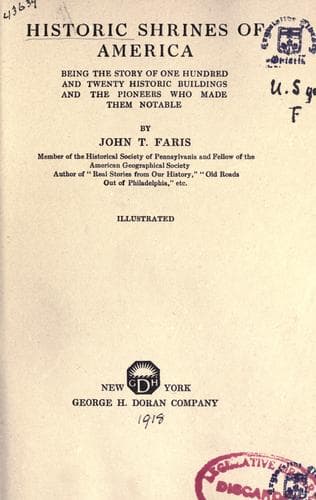
Historic Shrines of America: Being the Story of One Hundred and Twenty Historic Buildings and the Pioneers Who Made Them NotableFaris, John T. (John Thomson)
History
Historic Shrines of America: Being the Story of One Hundred and Twenty Historic Buildings and the Pioneers Who Made Them Notable
Faris, John T. (John Thomson)
Historic buildings -- United States; United States -- Biography
Not long after the beginning of life at Sherwood Forest he was
appointed overseer of the road on which his estate was located. Some
claimed that this appointment was secured by the Whigs to humiliate
him. But he refused to be humiliated. Instead he determined to be a
good overseer and make the road the best in the State. All the men in
the township were called, and they were kept at work day after day,
as, according to law, he had a right to keep them. But it was harvest
time, and the wheat was dead ripe. "The smiles that lately illuminated
the countenances of the Whigs turned to dismay. The august justice who
had made the appointment repaired to Mr. Tyler's house, and
represented to him the state of things. Mr. Tyler replied that the law
made it his duty to put the road in good order, and to keep it so. The
Whigs expostulated. Mr. Tyler was firm. Then the justice begged him to
resign, and let the hands go home. The ex-President said, 'Offices
are hard to obtain in these times, and having no assurance that I can
ever get another, I cannot think, under the circumstances, of
resigning.'"
One of the statesman's valued companions during these early years at
Sherwood Forest was "General," the old horse which he had owned for
many years. At length the horse died, and was buried in the grave at
Sherwood Forest. On a wooden slab at the head of the grave the owner
wrote:
"Here lieth the bones of my old horse, General, who served
his master faithfully for twenty-seven years, and never
blundered but once--would that his master could say the
same!"
The last years of John Tyler's life witnessed the return of his
popularity. Enemies became friends, and all rejoiced to do him honor.
He was called to a number of honorable posts, and he was about to take
his seat as a member of the House of Representatives of the
Confederate Congress when he died, in Richmond, on January 18, 1862.
[Illustration: HANOVER COURT HOUSE, VIRGINIA
_Photo by H. P. Cook_
See page 262]
LVII
TWO HISTORIC COURTHOUSES OF VIRGINIA
OLD DOMINION COUNTY BUILDINGS AT HANOVER AND WILLIAMSBURG
A momentous announcement appeared in the Williamsburg, Virginia,
_Gazette_ on March 16, 1769:
"The Common Hall having this day determined to build a
commodious brick court-house in this city and having
appointed us to agree with and undertake to build the same,
we do hereby give notice that we shall meet at Mr. Hay's (the
Raleigh Tavern) on Tuesday, the 4th of April, to let the
building thereof; we are also appointed to dispose of the
present court-house, and the ground on which the same stands.
James Cock, John Carter, James Carter, John Tazewell."
The building displaced by the new structure was erected in 1716 by
William Levington, and was given to the city in 1745 by "the Gentlemen
subscribers for the Play House."
Public-domain text, read in full here on John Shaqi.
Reviews
Reviews
No reviews yet
Be the first to share your thoughts on this work.
Elsewhere in the archive
Join the Discussion
Join the discussion
Sign in to leave a comment or review.
Sign InorCreate an account